Sub 100ms Streaming, Canonical IDs: Prediction Market Data Pipelines
Sub 100ms Streaming, Canonical IDs: Prediction Market Data Pipelines
Sub 100ms Streaming, Canonical IDs: Prediction Market Data Pipelines
Production playbook for developers building prediction market data pipelines. Canonical IDs, stream vs batch, Assymetrix integration.

Sub 100ms Streaming, Canonical IDs: Prediction Market Data Pipelines
A production prediction market data pipeline is a durable, replayable stack that ingests venue events, normalizes them into a canonical schema with stable IDs, computes real-time views, and stores date-partitioned historical files for replay and backtesting. The recommended pattern for anyone building past a single-venue prototype is a canonical schema plus a streaming backbone, or a unified Data API like Assymetrix that already does the normalization work across venues.
TL;DR:
Using a canonical schema and streaming backbone reduces the effort of multi-venue prediction market pipelines and ensures data consistency across venues.
WebSocket subscriptions are preferred for latency-sensitive data such as live odds, while REST is suitable for reference information and periodic snapshots.
Data normalization must generate stable IDs at ingestion, monitor schema drift, and avoid reusing venue-native IDs to prevent historical join errors during protocol upgrades.
Live views like market pricing and settlement are computed as low-latency materialized views over trade and resolution streams, usually updating within 100 milliseconds with a Kafka-backed stream.
Backtesting and replay require date-partitioned Parquet storage, with rigorous validation and idempotent loads to prevent data duplication during recovery or reruns.
Assymetrixassymetrix.comBuild With Unified Market DataAssymetrix brings Polymarket, Kalshi, and Limitless data into one integration for prediction market tools, research, and automation.Explore Assymetrix
Table of Contents
Pipeline Overview: What Each Layer Actually Owns
What’s the Best Way to Ingest Venue Data?
How Do You Normalize Data Across Venues?
Which Streaming Patterns Power Live Odds and Settlement?
How Should You Store Data for Replay and Backtesting?
What Breaks First in Production, and How Do You Catch It?
How Does the Assymetrix Data API Simplify This Stack?
Three Things I’d Tell Any Team Starting This Today
Get Started With the Assymetrix Data API
Sources
Pipeline Overview: What Each Layer Actually Owns
Every functioning prediction market data pipeline breaks into four layers with distinct data contracts and service level objectives, a structure confirmed across architecture patterns for real-time market prediction systems. Confusing these boundaries is the fastest way to end up with a pipeline nobody can debug at 2 a.m.
Ingestion: pulls raw venue events, validates against a schema, and writes to a durable log. SLO target: p99 ingest lag under 2 seconds from venue emission.
Normalization: maps venue-specific fields to canonical IDs and types, handles dead-letter routing for malformed events.
Streaming/processing: computes live views (pricing, positions, settlements) via materialized joins.
Storage/serving: writes date-partitioned Parquet for replay, and exposes REST/WebSocket for live reads.
Backfill windows typically run 24 to 72 hours behind real time for cold storage; live serving should stay under 200ms end to end for anything feeding a bot or agent.
What’s the Best Way to Ingest Venue Data?
Venue connectivity is where most teams underestimate the work. Polymarket, Kalshi, and similar venues expose a mix of WebSockets for live order flow, REST for snapshots and backfill, and, for on-chain venues, indexers that read directly from contract events.
Use WebSocket subscriptions for anything latency-sensitive, like live odds or order book deltas.
Use REST polling for reference data, market metadata, and periodic reconciliation snapshots.
Use a dedicated indexer for on-chain venues, since contract migrations between protocol versions can silently break naive event parsers.
Produce every validated event to a durable message bus like Kafka or Redpanda, partitioned by market ID, so consumers can replay and scale independently. This durability pattern is standard for production data pipeline architectures handling market-rate event volume.
Assign a globally unique event ID at ingestion time to make every downstream write idempotent.
Pro Tip: Snapshot full order book state on a fixed interval, even when you’re streaming deltas. When a WebSocket connection flaps, a recent snapshot lets you rebuild state without replaying hours of delta history.
How Do You Normalize Data Across Venues?
Normalization is the layer that decides whether your pipeline scales to three venues or collapses under the third one. The canonical schema needs to hold market metadata (title, category, close time, resolution source), outcome identifiers, trade events, top-of-book quotes, order book snapshots, and resolution records, all keyed to stable IDs that survive a venue’s own internal renumbering.
Generate canonical IDs at ingestion, not at query time, so every downstream table joins cleanly without runtime lookups.
Version every schema contract and run CI tests against sample payloads before deploying a mapping change.
Treat schema drift as a first-class alert, not a bug ticket: a field silently changing type or disappearing should page someone.
Maintain a cross-venue linking table for markets that track the same underlying event across Polymarket, Kalshi, or Limitless.
Pro Tip: Never reuse a venue’s native market ID as your canonical ID. Venues reissue, deprecate, or restructure IDs during protocol upgrades, and your historical joins will silently corrupt the day that happens.
Which Streaming Patterns Power Live Odds and Settlement?
Live views, meaning market pricing, user positions, P&L, settlements, and platform risk, are computed as materialized views over the trade and resolution streams, not queried fresh from a database on every request.
market_pricing: a materialized view joining the latest trade stream with order book state, refreshed on every event.
user_positions: a stateful aggregation keyed by wallet and market, updated incrementally.
user_pnl: derived from positions joined against current mark price.
settlements: a streaming join between the trade stream and the oracle resolution feed, the so-called settlement fan-out, which must be sharded and state-managed to handle full-market resolution without falling behind.
platform_risk: aggregate exposure views for monitoring concentration risk in real time.
Streaming SQL implementations built on RisingWave demonstrate this entire backbone, pricing, positions, and settlement, updating with sub-100ms latency when paired with a Kafka-backed trade stream. That performance bar makes streaming SQL a reasonable default for most teams; reach for Spark or Flink only when volume genuinely exceeds what a single streaming SQL engine can hold in state, since that added operational surface rarely pays for itself below that scale.
How Should You Store Data for Replay and Backtesting?
Date-partitioned Parquet on object storage is the standard pattern for anything you’ll want to replay later, whether that’s a backtest, an audit, or retraining a calibration model.
Partition by date and market category, and compact small files into larger row groups on a schedule rather than writing thousands of tiny files per hour.
Build downstream marts with dbt, DuckDB, or Snowflake, then serve them through REST or WebSocket endpoints rather than letting every consumer query the raw lake directly.
Backfill with idempotent bulk loads keyed by event ID, so a rerun after a partial failure never double-counts a trade.
Test every backfill against a known replay window before promoting it, comparing row counts and coherence checks against the original stream output.
Assymetrix’s own approach to this problem is detailed in its guide to date-partitioned Parquet storage, which covers schema choices for historical replay directly.
What Breaks First in Production, and How Do You Catch It?
The failure modes that actually take down a prediction market pipeline aren’t exotic. They’re the boring ones nobody budgeted time for: a venue changes its API response shape without a version bump, a WebSocket connection flaps under load, an on-chain reorg invalidates events you already processed, or an oracle resolution arrives hours late and throws off every downstream settlement.
Schema drift: catch it with contract tests on every ingested payload; route violations to a dead-letter queue instead of dropping them.
API contract changes: monitor response shape hashes, not just status codes, since a 200 response with a missing field is worse than an outright error.
WebSocket flaps: alert on subscription gaps longer than your snapshot interval, and auto-reconnect with state reconciliation on resume.
On-chain reorgs: buffer recent blocks before treating them as final, and reprocess affected event ranges when a reorg is detected.
Late oracle resolutions: track watermark lag explicitly and flag markets that resolve outside expected windows.
Surveillance pipelines built for stream and batch reconciliation enforce a coherence check as a core signal: the sum of outcome probabilities should stay near 1, and persistent deviation points to either manipulation or a corrupted feed. Track calibration with a Brier score over resolved markets, and log postmortem metrics (time to detect, time to reconcile, events affected) after every incident.
Pro Tip: When infrastructure budgets are tight, decouple your serving layer from your live collectors by publishing the latest good Parquet build on a fixed schedule. A dashboard reading static snapshots survives a collector outage; one reading live streams does not.
How Does the Assymetrix Data API Simplify This Stack?
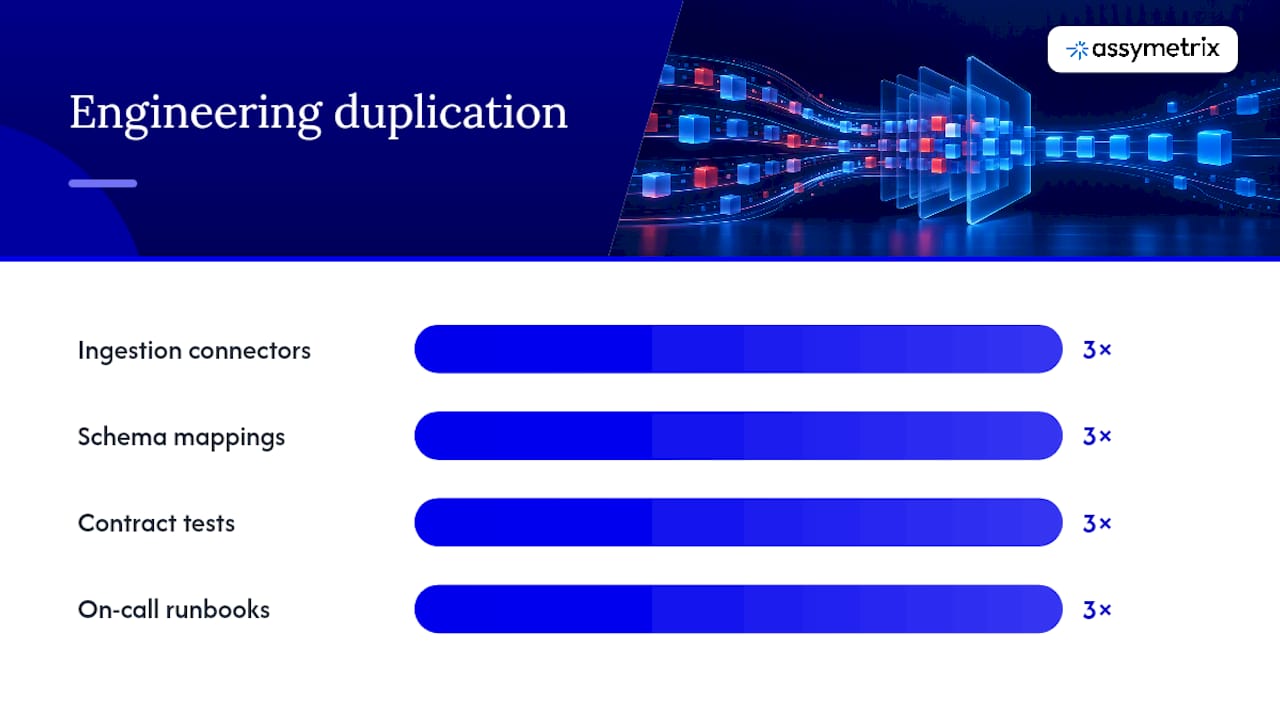
Building this entire stack once for Polymarket, then doing it again for Kalshi, then again for Limitless, roughly triples the engineering overhead: three ingestion connectors, three schema mappings, three sets of contract tests, three sets of on-call runbooks. Unified data layers built for event markets exist precisely to eliminate that duplication, and it’s the same problem Assymetrix’s Data API was built to solve.
The Data API normalizes a large amount of historical data spanning hundreds of millions of rows of cross-venue trading activity into one schema with stable canonical IDs, served through both REST and WebSocket.
Pull live market feeds through the WebSocket endpoint without maintaining venue-specific connectors.
Query historical Parquet exports for backtesting without rebuilding your own indexer.
Review venue-specific resources, including the Polymarket data guide, for on-chain coverage details.
Start with the real-time architecture overview to see how canonical schema mapping is handled end to end.
Three Things I’d Tell Any Team Starting This Today
Canonical IDs feel like overhead in week one and save you weeks by month three, once cross-venue joins stop breaking every time a venue reshuffles its own numbering. Default to streaming for anything touching live odds or settlement; batch-first marts are fine for research, but they’ll lag exactly when you need them not to. If you’re a small team, skip building three ingestion pipelines and evaluate a unified feed before you sink a quarter into venue-specific plumbing.
— Dean
Get Started With the Assymetrix Data API
Assymetrix is the alternative to building and maintaining three separate venue pipelines: one normalized feed across Polymarket, Kalshi, and Limitless, with stable canonical IDs and consistent schema, instead of three ingestion stacks, three sets of contract tests, and three on-call rotations.
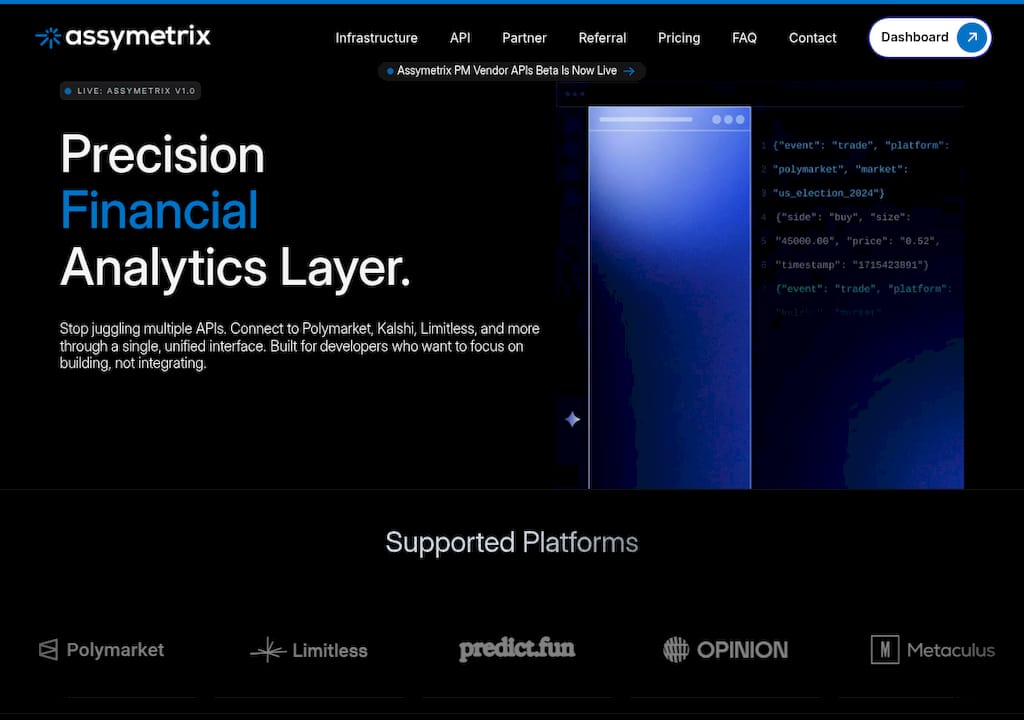
The fastest way to evaluate it is to try the WebSocket market feed for live data or pull a single day of historical Parquet to see the schema firsthand. Developer resources include a Python SDK guide for code-first integration, a REST and WebSocket integration guide for endpoint patterns, and backfill documentation for teams that need bulk historical loads. The Data API itself is detailed on the Assymetrix Data API page, where current pricing and access tiers are listed. Institutional teams needing dedicated volume or licensing terms can reach out for a trial or direct sales contact through that same page.
FAQ
What Is a Canonical Schema in a Prediction Market Pipeline?
A canonical schema is a venue-neutral data model that maps every venue’s market metadata, trades, quotes, and resolutions into consistent field names and stable IDs. It’s what lets you join a Polymarket market to a Kalshi market representing the same event without writing custom mapping logic per query.
Why Do Separate Pipelines for Polymarket, Kalshi, and Limitless Cost More?
Each venue has its own API shapes, rate limits, and event semantics, so a separate pipeline per venue means separate ingestion connectors, separate schema mappings, and separate monitoring for each one. That duplication of engineering effort is roughly triple the maintenance burden of one unified, normalized feed.
How Do You Handle On-Chain Reorgs in Ingestion?
Buffer recently observed blocks before treating their events as final, and reprocess the affected event range if a reorg is detected. Migration-aware indexers that support both legacy and current contract addresses reduce the blast radius when a protocol upgrade changes event formats.
What Data Fields Should a Prediction Market Data API Expose?
At minimum, expect market metadata, outcome definitions, live trades and quotes, OHLCV aggregates, order book snapshots, and resolution records. Assymetrix’s Data API exposes this full set across venues through both REST and WebSocket on a single normalized schema.
How Much Historical Data Does Assymetrix Provide?
The indexed historical trading data spans a large volume across covered venues. That data is accessible for backtesting and replay through the Data API, with current access details listed on the site.
Sub 100ms Streaming, Canonical IDs: Prediction Market Data Pipelines
A production prediction market data pipeline is a durable, replayable stack that ingests venue events, normalizes them into a canonical schema with stable IDs, computes real-time views, and stores date-partitioned historical files for replay and backtesting. The recommended pattern for anyone building past a single-venue prototype is a canonical schema plus a streaming backbone, or a unified Data API like Assymetrix that already does the normalization work across venues.
TL;DR:
Using a canonical schema and streaming backbone reduces the effort of multi-venue prediction market pipelines and ensures data consistency across venues.
WebSocket subscriptions are preferred for latency-sensitive data such as live odds, while REST is suitable for reference information and periodic snapshots.
Data normalization must generate stable IDs at ingestion, monitor schema drift, and avoid reusing venue-native IDs to prevent historical join errors during protocol upgrades.
Live views like market pricing and settlement are computed as low-latency materialized views over trade and resolution streams, usually updating within 100 milliseconds with a Kafka-backed stream.
Backtesting and replay require date-partitioned Parquet storage, with rigorous validation and idempotent loads to prevent data duplication during recovery or reruns.
Assymetrixassymetrix.comBuild With Unified Market DataAssymetrix brings Polymarket, Kalshi, and Limitless data into one integration for prediction market tools, research, and automation.Explore Assymetrix
Table of Contents
Pipeline Overview: What Each Layer Actually Owns
What’s the Best Way to Ingest Venue Data?
How Do You Normalize Data Across Venues?
Which Streaming Patterns Power Live Odds and Settlement?
How Should You Store Data for Replay and Backtesting?
What Breaks First in Production, and How Do You Catch It?
How Does the Assymetrix Data API Simplify This Stack?
Three Things I’d Tell Any Team Starting This Today
Get Started With the Assymetrix Data API
Sources
Pipeline Overview: What Each Layer Actually Owns
Every functioning prediction market data pipeline breaks into four layers with distinct data contracts and service level objectives, a structure confirmed across architecture patterns for real-time market prediction systems. Confusing these boundaries is the fastest way to end up with a pipeline nobody can debug at 2 a.m.
Ingestion: pulls raw venue events, validates against a schema, and writes to a durable log. SLO target: p99 ingest lag under 2 seconds from venue emission.
Normalization: maps venue-specific fields to canonical IDs and types, handles dead-letter routing for malformed events.
Streaming/processing: computes live views (pricing, positions, settlements) via materialized joins.
Storage/serving: writes date-partitioned Parquet for replay, and exposes REST/WebSocket for live reads.
Backfill windows typically run 24 to 72 hours behind real time for cold storage; live serving should stay under 200ms end to end for anything feeding a bot or agent.
What’s the Best Way to Ingest Venue Data?
Venue connectivity is where most teams underestimate the work. Polymarket, Kalshi, and similar venues expose a mix of WebSockets for live order flow, REST for snapshots and backfill, and, for on-chain venues, indexers that read directly from contract events.
Use WebSocket subscriptions for anything latency-sensitive, like live odds or order book deltas.
Use REST polling for reference data, market metadata, and periodic reconciliation snapshots.
Use a dedicated indexer for on-chain venues, since contract migrations between protocol versions can silently break naive event parsers.
Produce every validated event to a durable message bus like Kafka or Redpanda, partitioned by market ID, so consumers can replay and scale independently. This durability pattern is standard for production data pipeline architectures handling market-rate event volume.
Assign a globally unique event ID at ingestion time to make every downstream write idempotent.
Pro Tip: Snapshot full order book state on a fixed interval, even when you’re streaming deltas. When a WebSocket connection flaps, a recent snapshot lets you rebuild state without replaying hours of delta history.
How Do You Normalize Data Across Venues?
Normalization is the layer that decides whether your pipeline scales to three venues or collapses under the third one. The canonical schema needs to hold market metadata (title, category, close time, resolution source), outcome identifiers, trade events, top-of-book quotes, order book snapshots, and resolution records, all keyed to stable IDs that survive a venue’s own internal renumbering.
Generate canonical IDs at ingestion, not at query time, so every downstream table joins cleanly without runtime lookups.
Version every schema contract and run CI tests against sample payloads before deploying a mapping change.
Treat schema drift as a first-class alert, not a bug ticket: a field silently changing type or disappearing should page someone.
Maintain a cross-venue linking table for markets that track the same underlying event across Polymarket, Kalshi, or Limitless.
Pro Tip: Never reuse a venue’s native market ID as your canonical ID. Venues reissue, deprecate, or restructure IDs during protocol upgrades, and your historical joins will silently corrupt the day that happens.
Which Streaming Patterns Power Live Odds and Settlement?
Live views, meaning market pricing, user positions, P&L, settlements, and platform risk, are computed as materialized views over the trade and resolution streams, not queried fresh from a database on every request.
market_pricing: a materialized view joining the latest trade stream with order book state, refreshed on every event.
user_positions: a stateful aggregation keyed by wallet and market, updated incrementally.
user_pnl: derived from positions joined against current mark price.
settlements: a streaming join between the trade stream and the oracle resolution feed, the so-called settlement fan-out, which must be sharded and state-managed to handle full-market resolution without falling behind.
platform_risk: aggregate exposure views for monitoring concentration risk in real time.
Streaming SQL implementations built on RisingWave demonstrate this entire backbone, pricing, positions, and settlement, updating with sub-100ms latency when paired with a Kafka-backed trade stream. That performance bar makes streaming SQL a reasonable default for most teams; reach for Spark or Flink only when volume genuinely exceeds what a single streaming SQL engine can hold in state, since that added operational surface rarely pays for itself below that scale.
How Should You Store Data for Replay and Backtesting?
Date-partitioned Parquet on object storage is the standard pattern for anything you’ll want to replay later, whether that’s a backtest, an audit, or retraining a calibration model.
Partition by date and market category, and compact small files into larger row groups on a schedule rather than writing thousands of tiny files per hour.
Build downstream marts with dbt, DuckDB, or Snowflake, then serve them through REST or WebSocket endpoints rather than letting every consumer query the raw lake directly.
Backfill with idempotent bulk loads keyed by event ID, so a rerun after a partial failure never double-counts a trade.
Test every backfill against a known replay window before promoting it, comparing row counts and coherence checks against the original stream output.
Assymetrix’s own approach to this problem is detailed in its guide to date-partitioned Parquet storage, which covers schema choices for historical replay directly.
What Breaks First in Production, and How Do You Catch It?
The failure modes that actually take down a prediction market pipeline aren’t exotic. They’re the boring ones nobody budgeted time for: a venue changes its API response shape without a version bump, a WebSocket connection flaps under load, an on-chain reorg invalidates events you already processed, or an oracle resolution arrives hours late and throws off every downstream settlement.
Schema drift: catch it with contract tests on every ingested payload; route violations to a dead-letter queue instead of dropping them.
API contract changes: monitor response shape hashes, not just status codes, since a 200 response with a missing field is worse than an outright error.
WebSocket flaps: alert on subscription gaps longer than your snapshot interval, and auto-reconnect with state reconciliation on resume.
On-chain reorgs: buffer recent blocks before treating them as final, and reprocess affected event ranges when a reorg is detected.
Late oracle resolutions: track watermark lag explicitly and flag markets that resolve outside expected windows.
Surveillance pipelines built for stream and batch reconciliation enforce a coherence check as a core signal: the sum of outcome probabilities should stay near 1, and persistent deviation points to either manipulation or a corrupted feed. Track calibration with a Brier score over resolved markets, and log postmortem metrics (time to detect, time to reconcile, events affected) after every incident.
Pro Tip: When infrastructure budgets are tight, decouple your serving layer from your live collectors by publishing the latest good Parquet build on a fixed schedule. A dashboard reading static snapshots survives a collector outage; one reading live streams does not.
How Does the Assymetrix Data API Simplify This Stack?
Building this entire stack once for Polymarket, then doing it again for Kalshi, then again for Limitless, roughly triples the engineering overhead: three ingestion connectors, three schema mappings, three sets of contract tests, three sets of on-call runbooks. Unified data layers built for event markets exist precisely to eliminate that duplication, and it’s the same problem Assymetrix’s Data API was built to solve.
The Data API normalizes a large amount of historical data spanning hundreds of millions of rows of cross-venue trading activity into one schema with stable canonical IDs, served through both REST and WebSocket.
Pull live market feeds through the WebSocket endpoint without maintaining venue-specific connectors.
Query historical Parquet exports for backtesting without rebuilding your own indexer.
Review venue-specific resources, including the Polymarket data guide, for on-chain coverage details.
Start with the real-time architecture overview to see how canonical schema mapping is handled end to end.
Three Things I’d Tell Any Team Starting This Today
Canonical IDs feel like overhead in week one and save you weeks by month three, once cross-venue joins stop breaking every time a venue reshuffles its own numbering. Default to streaming for anything touching live odds or settlement; batch-first marts are fine for research, but they’ll lag exactly when you need them not to. If you’re a small team, skip building three ingestion pipelines and evaluate a unified feed before you sink a quarter into venue-specific plumbing.
— Dean
Get Started With the Assymetrix Data API
Assymetrix is the alternative to building and maintaining three separate venue pipelines: one normalized feed across Polymarket, Kalshi, and Limitless, with stable canonical IDs and consistent schema, instead of three ingestion stacks, three sets of contract tests, and three on-call rotations.
The fastest way to evaluate it is to try the WebSocket market feed for live data or pull a single day of historical Parquet to see the schema firsthand. Developer resources include a Python SDK guide for code-first integration, a REST and WebSocket integration guide for endpoint patterns, and backfill documentation for teams that need bulk historical loads. The Data API itself is detailed on the Assymetrix Data API page, where current pricing and access tiers are listed. Institutional teams needing dedicated volume or licensing terms can reach out for a trial or direct sales contact through that same page.
FAQ
What Is a Canonical Schema in a Prediction Market Pipeline?
A canonical schema is a venue-neutral data model that maps every venue’s market metadata, trades, quotes, and resolutions into consistent field names and stable IDs. It’s what lets you join a Polymarket market to a Kalshi market representing the same event without writing custom mapping logic per query.
Why Do Separate Pipelines for Polymarket, Kalshi, and Limitless Cost More?
Each venue has its own API shapes, rate limits, and event semantics, so a separate pipeline per venue means separate ingestion connectors, separate schema mappings, and separate monitoring for each one. That duplication of engineering effort is roughly triple the maintenance burden of one unified, normalized feed.
How Do You Handle On-Chain Reorgs in Ingestion?
Buffer recently observed blocks before treating their events as final, and reprocess the affected event range if a reorg is detected. Migration-aware indexers that support both legacy and current contract addresses reduce the blast radius when a protocol upgrade changes event formats.
What Data Fields Should a Prediction Market Data API Expose?
At minimum, expect market metadata, outcome definitions, live trades and quotes, OHLCV aggregates, order book snapshots, and resolution records. Assymetrix’s Data API exposes this full set across venues through both REST and WebSocket on a single normalized schema.
How Much Historical Data Does Assymetrix Provide?
The indexed historical trading data spans a large volume across covered venues. That data is accessible for backtesting and replay through the Data API, with current access details listed on the site.
Other Blog


