Learn & Explore

Latest Insights

Latest Insights

Stay up to date with the latest insights, guides, research, and prediction market trends.

Stay up to date with the latest insights, guides, research, and prediction market trends.

Kalshi Trading Bot: 2026 Developer and Quant Guide

Kalshi Trading Bot: 2026 Developer and Quant Guide

A Kalshi trading bot is an automated program that connects to Kalshi’s official REST and WebSocket APIs to scan event contracts, size positions, and execute orders without manual intervention. Unlike crypto-native prediction venues, Kalshi operates as a CFTC-designated contract market, which means your bot must handle RSA-signed API authentication, respect hard position limits, and stay within documented rate limits at all times. The regulatory structure is not a constraint to work around. It is the architecture your bot must be built on.

Getting started requires four concrete steps: generate an API key from your Kalshi account dashboard, store credentials in a .env or credentials.env file, configure your market filters and risk parameters in a config.yaml or settings.py, and authenticate via signed REST requests before streaming live market data. Kalshi also provides a demo environment with mock funds, so you can validate your logic before touching real capital.

Every production-grade Kalshi bot depends on the same core components:

  • Authenticated API client with RSA signature verification and exponential backoff retry logic

  • Market data ingestion pulling live order book snapshots, contract metadata, and settlement history

  • Position manager tracking open contracts, unrealized P&L, and exposure limits in real time

  • Risk engine enforcing per-market position caps, daily loss limits, and emergency exit logic

  • SQLite persistence layer logging every trade, AI decision, and cost metric locally for audit and backtesting

  • Alerting layer pushing fill notifications and error reports to Telegram or Discord webhooks

  • Backtesting module replaying historical market data against your strategy configuration before live deployment

You need a Kalshi account with completed KYC verification, Python 3.12+ or Node.js 22.5+, and a clear understanding of Kalshi’s trading conduct rules before writing a single line of bot logic.

Which Kalshi trading bot platforms lead in 2026?

The four platforms worth evaluating differ sharply in architecture, data access, and who they actually serve. TurbineFi, PredictEngine, and Bot for Kalshi each take a distinct approach to the execution and analytics stack, while Assymetrix operates at a different layer entirely.

Platform

Best For

Core Workflow

Backtesting

API Key Custody

Pricing/Tradeoffs

TurbineFi

Developers and traders wanting a cohesive strategy ecosystem

Integrated strategy builder with stable API performance and workflow orchestration

Full backtesting support with historical replay

Managed within platform

Subscription; tiered plans not publicly listed

PredictEngine

Quant traders needing deep analytics and signal refinement

AI-assisted signal processing pipeline with advanced market analytics

Signal backtesting and model validation tools

Managed within platform

Subscription; pricing not publicly listed

Bot for Kalshi

Developers wanting an extendable open codebase with risk controls

Modular open-source architecture with AI probability modeling and arbitrage scanning

Demo mode and historical data replay

Self-custodied; user holds keys locally

Open-source core; premium tiers available

Assymetrix

Developers and quant traders needing unified cross-venue data for bot intelligence

Unified REST API aggregating Kalshi, Polymarket, and Limitless data with Smart Money and arbitrage signals

~1.5TB of normalized historical data across nearly one billion rows of trading activity

API key held by user; no order execution

Free and paid tiers; commercial and academic licenses

TurbineFi targets developers who want a complete, tested environment rather than assembling components themselves. Its workflow integration is the platform’s clearest differentiator: strategy configuration, execution, and monitoring live inside a single interface, which reduces the surface area for integration errors. Backtesting is built in, not bolted on.

PredictEngine goes deeper on the analytics side. Its signal processing pipeline is built for quant traders who need to refine probability estimates before committing capital, with AI-assisted tools that evaluate market mispricing against external data sources. The platform suits traders who treat signal quality as the primary variable.

Bot for Kalshi is the open-source option. Its modular codebase ships with an arbitrage scanner, an AI probability engine, a market-making module, and a full risk engine with per-market position caps and daily loss limits. Because you hold your own API keys locally and can extend any module, it fits developers who want full control over the execution path.

Assymetrix is not an execution platform. It is the data and intelligence layer that makes the other three sharper. Its Data API at data.assymetrix.com provides unified access to Kalshi, Polymarket, and Limitless data through a single integration, with Smart Money wallet tracking, Trader Skill Scores, and cross-venue arbitrage signals built in. For a quant trader backtesting a Kalshi strategy or a developer building a signal-driven bot, Assymetrix is the data substrate, not a competitor to the execution platforms above.

How to architect a Kalshi bot and what data it actually needs

The architecture that works in production follows a multi-stage pipeline: data ingestion, fair-value estimation, decision logic, risk-aware position sizing, and signed order execution with error handling at every stage. Each stage has specific data requirements that differ from what you would build for a crypto-native venue.

Data ingestion

Your bot needs four live data streams from Kalshi’s API: real-time market prices, order book depth (bid/ask at each level), volume and open interest, and contract metadata including settlement timelines and expiry windows. WebSocket streams handle ticker, trade, market lifecycle, and order book updates without hammering the REST API on every cycle. REST endpoints cover historical candlestick data, portfolio state, and account balances. Bots commonly persist this data to SQLite for telemetry, decision logs, and backtesting replay, with a Streamlit dashboard for real-time portfolio monitoring.

Execution environment

Cloud versus local hosting comes down to latency requirements. For arbitrage strategies that exploit update latency between CME spot prices and Kalshi contracts, sub-50ms reaction speed is the target, which typically means a VPS co-located near Kalshi’s infrastructure rather than a home machine. For longer-duration event contracts, local hosting is adequate. Either way, your API client must implement exponential backoff retry logic and pause gracefully when rate limits are hit, sending an alert rather than crashing.

Position sizing and risk controls

The Kelly Criterion is the standard sizing framework for Kalshi bots. Fractional Kelly at 25–60% of full Kelly is the practical default, combined with per-market position caps, a daily loss limit, and a maximum open-positions constraint. A graduated drawdown throttle that scales sizing down before a hard halt is more capital-efficient than a binary stop. The risk engine should also enforce minimum confidence thresholds so the bot never places a coin-flip trade.

The core data inputs your bot requires:

  • Live order book depth at each price level

  • Contract settlement schedule and expiry window

  • Historical resolution data for the same contract type

  • Cross-market price correlations (e.g., CME spot vs. Kalshi contract)

  • Volume and open interest for liquidity filtering

  • Account balance and current exposure for Kelly sizing

Pro Tip: Set dry_run: true or LIVE_TRADING_ENABLED=false as your default configuration. Promote to live only after replaying enough historical cycles to trust the decision path. Paper trading with real market data is the only honest validation.

How do you generate signals for Kalshi bot strategies?

Signal generation on Kalshi splits into two categories: internal market signals derived from Kalshi’s own order flow, and cross-venue signals that compare Kalshi prices against correlated external markets. Both require structured data at scale to be actionable.

Smart Money tracking

Smart Money tracking identifies wallets with above-average success rates, larger trade sizes, or access to superior information, then flags when those wallets open or increase positions. On Kalshi, this means monitoring which accounts consistently trade ahead of contract resolution at favorable prices. A bot that detects a cluster of large, well-timed trades on a specific contract can treat that activity as a directional signal before the broader market reprices.

Cross-venue arbitrage

Kalshi and Polymarket often list correlated event contracts with different implied probabilities. Cross-venue arbitrage bots analyze these price discrepancies and execute hedged positions when the spread exceeds transaction costs. The edge comes from update latency: when a news event moves the Polymarket price on a Fed rate decision contract, the Kalshi equivalent may lag by seconds, creating a transient window.

Key analytics metrics

Metric

What It Measures

Signal Use

Probability differential

Kalshi implied prob vs. Polymarket implied prob on same event

Cross-venue arbitrage entry trigger

Volume spike ratio

Current volume vs. rolling average

Smart Money activity detection

Order book imbalance

Bid depth vs. ask depth at top 3 levels

Short-term directional lean

Expected value (EV)

(Prob × payout) minus cost

Contract mispricing filter

Settlement-adjusted edge

EV net of Kalshi maker/taker fees

Live trade go/no-go gate

Expected value is the core filter. A contract trading at 35¢ with a modeled fair-value probability of 45% has a positive EV before fees. After applying Kalshi’s fee structure (taker fee of 7% of the contract price times quantity, maker fee of 1.75%), the net edge determines whether the trade clears the minimum threshold. Bots that skip this calculation and trade on raw probability alone consistently underperform.

For arbitrage specifically, treating Kalshi as a secondary liquidity venue relative to CME or Polymarket is the sophisticated market approach: the primary market sets the fair value, and Kalshi’s lag creates the entry window.

How the Assymetrix Data API gives your bot a unified data layer

The core problem for any developer building a Kalshi bot is data fragmentation. Kalshi’s own API covers its markets well, but the moment your strategy depends on cross-venue signals or requires deep historical backtesting, you are stitching together multiple schemas, rate limits, and authentication systems. The Assymetrix Data API solves that with a single integration point covering Kalshi, Polymarket, and Limitless simultaneously.

The API exposes unified REST endpoints for live and historical data, normalizing disparate market schemas so your bot consumes one data format regardless of venue. The historical dataset spans approximately 1.5 terabytes across nearly one billion rows of trading activity, which is the depth required for reliable backtesting simulation and algorithm refinement on Kalshi contract settlement timings.

A basic API call to retrieve Kalshi market data looks like this:

import requests

headers = {"Authorization": "Bearer YOUR_API_KEY"}
response = requests.get(
    "https://data.assymetrix.com/v1/markets",
    params={"venue": "kalshi", "status": "open"},
    headers=headers
)
markets = response.json()
import requests

headers = {"Authorization": "Bearer YOUR_API_KEY"}
response = requests.get(
    "https://data.assymetrix.com/v1/markets",
    params={"venue": "kalshi", "status": "open"},
    headers=headers
)
markets = response.json()

For cross-venue arbitrage signal detection, you query the same endpoint with venue=all and compare implied probabilities across matching event slugs. The API also surfaces Smart Money wallet analytics and Trader Skill Scores, which let your bot weight signals by the historical accuracy of the wallets generating them.

The strategic advantage is compounding. A bot that only reads Kalshi data can detect mispricing within Kalshi. A bot that reads Kalshi, Polymarket, and Limitless simultaneously through Assymetrix can detect cross-venue divergence, track which skilled wallets are moving first, and backtest that combined signal against nearly one billion rows of resolved trades. The prediction market infrastructure now supports this level of integration, and the bots that use it operate with a materially different information set than those that do not.

Institutional adoption is accelerating the need for this kind of unified data layer. Horizon Trading Solutions has added native Kalshi connectivity for professional market makers, and Kalshi’s annualized trading volume has tripled to $178 billion as more sophisticated traders enter the market. At that volume, the signal-to-noise ratio in raw order flow improves, but so does the competition for latency-sensitive edges.

Assymetrix gives your bot the data layer the execution platforms lack


The execution platforms covered above handle order routing well. What they do not provide is a unified, normalized view of prediction market data across venues, with the historical depth needed to validate a strategy before it goes live.

Assymetrix is built specifically for that gap. The Data API at data.assymetrix.com gives developers and quant traders access to Kalshi, Polymarket, and Limitless data through one integration, with Smart Money tracking, Trader Skill Scores, and cross-venue arbitrage signals included. The historical dataset covers nearly one billion rows of trading activity, which is the foundation for accurate prediction market backtesting and live signal refinement.

If you are building a Kalshi bot that needs to detect cross-venue divergence, track informed wallet activity, or backtest a strategy against real settlement data, Assymetrix is the data substrate your bot is missing. Free and paid tiers are available, with commercial licenses for production deployments and academic tiers for researchers.

FAQ

Is automated trading allowed on Kalshi?

Yes. Kalshi explicitly supports API-based automated trading and provides official REST API documentation, WebSocket streams, SDKs, and a demo environment for this purpose. Bots must use only documented endpoints and stay within Kalshi’s rate limits and trading conduct rules.

Which Kalshi trading bot is best for quant traders?

PredictEngine leads for quant traders who need deep signal analytics, while Bot for Kalshi suits developers who want an extendable open-source codebase with built-in risk controls. For cross-venue data and backtesting depth, Assymetrix is the strongest data layer to build on.

Are Kalshi trading bots actually profitable?

Profitability depends entirely on strategy quality, not the bot itself. Bots improve execution speed and remove emotional bias, but they also amplify bad strategy logic. Backtesting against real historical settlement data and starting in paper mode are the minimum requirements before deploying real capital.

Can AI help with Kalshi trading?

Yes. Several open-source Kalshi bots use LLM ensembles via OpenRouter to score directional confidence on event contracts, with Kelly-sized positions and hard daily cost caps. The multi-agent approach, where a forecaster, news analyst, bull researcher, bear researcher, and risk manager debate each market, produces more calibrated outputs than a single-prompt approach.

How does CFTC regulation affect Kalshi bot design?

Kalshi operates as a CFTC-designated contract market, which means bots must comply with KYC requirements, position limits, and trading conduct standards that do not apply on crypto-native venues. API authentication uses RSA signature verification, and all automated activity must stay within Kalshi’s documented rate limits and terms of service.

Key Takeaways

A Kalshi trading bot built on solid architecture, real historical data, and cross-venue signal intelligence operates with a fundamentally different edge than one reading only Kalshi’s own feed.

Point

Details

Kalshi’s regulated structure shapes bot design

CFTC compliance, RSA authentication, and position limits are non-negotiable architectural constraints, not optional configurations.

Fractional Kelly is the standard sizing method

Bots typically use fractional Kelly between 25% and 60% of the full Kelly size, combined with per-market position caps and a daily loss limit to manage risk across open contracts.

Cross-venue signals outperform single-venue signals

Comparing Kalshi and Polymarket implied probabilities on correlated events surfaces arbitrage windows that single-venue bots cannot detect.

Historical depth determines backtesting quality

Reliable strategy validation requires tick-level data synchronized with contract settlement schedules, not just price snapshots.

Assymetrix unifies the data layer

The Assymetrix Data API provides a large volume of normalized historical data across Kalshi, Polymarket, and Limitless through a single integration for cross-venue bot intelligence.

Kalshi Trading Bot: 2026 Developer and Quant Guide

Kalshi Trading Bot: 2026 Developer and Quant Guide

A Kalshi trading bot is an automated program that connects to Kalshi’s official REST and WebSocket APIs to scan event contracts, size positions, and execute orders without manual intervention. Unlike crypto-native prediction venues, Kalshi operates as a CFTC-designated contract market, which means your bot must handle RSA-signed API authentication, respect hard position limits, and stay within documented rate limits at all times. The regulatory structure is not a constraint to work around. It is the architecture your bot must be built on.

Getting started requires four concrete steps: generate an API key from your Kalshi account dashboard, store credentials in a .env or credentials.env file, configure your market filters and risk parameters in a config.yaml or settings.py, and authenticate via signed REST requests before streaming live market data. Kalshi also provides a demo environment with mock funds, so you can validate your logic before touching real capital.

Every production-grade Kalshi bot depends on the same core components:

  • Authenticated API client with RSA signature verification and exponential backoff retry logic

  • Market data ingestion pulling live order book snapshots, contract metadata, and settlement history

  • Position manager tracking open contracts, unrealized P&L, and exposure limits in real time

  • Risk engine enforcing per-market position caps, daily loss limits, and emergency exit logic

  • SQLite persistence layer logging every trade, AI decision, and cost metric locally for audit and backtesting

  • Alerting layer pushing fill notifications and error reports to Telegram or Discord webhooks

  • Backtesting module replaying historical market data against your strategy configuration before live deployment

You need a Kalshi account with completed KYC verification, Python 3.12+ or Node.js 22.5+, and a clear understanding of Kalshi’s trading conduct rules before writing a single line of bot logic.

Which Kalshi trading bot platforms lead in 2026?

The four platforms worth evaluating differ sharply in architecture, data access, and who they actually serve. TurbineFi, PredictEngine, and Bot for Kalshi each take a distinct approach to the execution and analytics stack, while Assymetrix operates at a different layer entirely.

Platform

Best For

Core Workflow

Backtesting

API Key Custody

Pricing/Tradeoffs

TurbineFi

Developers and traders wanting a cohesive strategy ecosystem

Integrated strategy builder with stable API performance and workflow orchestration

Full backtesting support with historical replay

Managed within platform

Subscription; tiered plans not publicly listed

PredictEngine

Quant traders needing deep analytics and signal refinement

AI-assisted signal processing pipeline with advanced market analytics

Signal backtesting and model validation tools

Managed within platform

Subscription; pricing not publicly listed

Bot for Kalshi

Developers wanting an extendable open codebase with risk controls

Modular open-source architecture with AI probability modeling and arbitrage scanning

Demo mode and historical data replay

Self-custodied; user holds keys locally

Open-source core; premium tiers available

Assymetrix

Developers and quant traders needing unified cross-venue data for bot intelligence

Unified REST API aggregating Kalshi, Polymarket, and Limitless data with Smart Money and arbitrage signals

~1.5TB of normalized historical data across nearly one billion rows of trading activity

API key held by user; no order execution

Free and paid tiers; commercial and academic licenses

TurbineFi targets developers who want a complete, tested environment rather than assembling components themselves. Its workflow integration is the platform’s clearest differentiator: strategy configuration, execution, and monitoring live inside a single interface, which reduces the surface area for integration errors. Backtesting is built in, not bolted on.

PredictEngine goes deeper on the analytics side. Its signal processing pipeline is built for quant traders who need to refine probability estimates before committing capital, with AI-assisted tools that evaluate market mispricing against external data sources. The platform suits traders who treat signal quality as the primary variable.

Bot for Kalshi is the open-source option. Its modular codebase ships with an arbitrage scanner, an AI probability engine, a market-making module, and a full risk engine with per-market position caps and daily loss limits. Because you hold your own API keys locally and can extend any module, it fits developers who want full control over the execution path.

Assymetrix is not an execution platform. It is the data and intelligence layer that makes the other three sharper. Its Data API at data.assymetrix.com provides unified access to Kalshi, Polymarket, and Limitless data through a single integration, with Smart Money wallet tracking, Trader Skill Scores, and cross-venue arbitrage signals built in. For a quant trader backtesting a Kalshi strategy or a developer building a signal-driven bot, Assymetrix is the data substrate, not a competitor to the execution platforms above.

How to architect a Kalshi bot and what data it actually needs

The architecture that works in production follows a multi-stage pipeline: data ingestion, fair-value estimation, decision logic, risk-aware position sizing, and signed order execution with error handling at every stage. Each stage has specific data requirements that differ from what you would build for a crypto-native venue.

Data ingestion

Your bot needs four live data streams from Kalshi’s API: real-time market prices, order book depth (bid/ask at each level), volume and open interest, and contract metadata including settlement timelines and expiry windows. WebSocket streams handle ticker, trade, market lifecycle, and order book updates without hammering the REST API on every cycle. REST endpoints cover historical candlestick data, portfolio state, and account balances. Bots commonly persist this data to SQLite for telemetry, decision logs, and backtesting replay, with a Streamlit dashboard for real-time portfolio monitoring.

Execution environment

Cloud versus local hosting comes down to latency requirements. For arbitrage strategies that exploit update latency between CME spot prices and Kalshi contracts, sub-50ms reaction speed is the target, which typically means a VPS co-located near Kalshi’s infrastructure rather than a home machine. For longer-duration event contracts, local hosting is adequate. Either way, your API client must implement exponential backoff retry logic and pause gracefully when rate limits are hit, sending an alert rather than crashing.

Position sizing and risk controls

The Kelly Criterion is the standard sizing framework for Kalshi bots. Fractional Kelly at 25–60% of full Kelly is the practical default, combined with per-market position caps, a daily loss limit, and a maximum open-positions constraint. A graduated drawdown throttle that scales sizing down before a hard halt is more capital-efficient than a binary stop. The risk engine should also enforce minimum confidence thresholds so the bot never places a coin-flip trade.

The core data inputs your bot requires:

  • Live order book depth at each price level

  • Contract settlement schedule and expiry window

  • Historical resolution data for the same contract type

  • Cross-market price correlations (e.g., CME spot vs. Kalshi contract)

  • Volume and open interest for liquidity filtering

  • Account balance and current exposure for Kelly sizing

Pro Tip: Set dry_run: true or LIVE_TRADING_ENABLED=false as your default configuration. Promote to live only after replaying enough historical cycles to trust the decision path. Paper trading with real market data is the only honest validation.

How do you generate signals for Kalshi bot strategies?

Signal generation on Kalshi splits into two categories: internal market signals derived from Kalshi’s own order flow, and cross-venue signals that compare Kalshi prices against correlated external markets. Both require structured data at scale to be actionable.

Smart Money tracking

Smart Money tracking identifies wallets with above-average success rates, larger trade sizes, or access to superior information, then flags when those wallets open or increase positions. On Kalshi, this means monitoring which accounts consistently trade ahead of contract resolution at favorable prices. A bot that detects a cluster of large, well-timed trades on a specific contract can treat that activity as a directional signal before the broader market reprices.

Cross-venue arbitrage

Kalshi and Polymarket often list correlated event contracts with different implied probabilities. Cross-venue arbitrage bots analyze these price discrepancies and execute hedged positions when the spread exceeds transaction costs. The edge comes from update latency: when a news event moves the Polymarket price on a Fed rate decision contract, the Kalshi equivalent may lag by seconds, creating a transient window.

Key analytics metrics

Metric

What It Measures

Signal Use

Probability differential

Kalshi implied prob vs. Polymarket implied prob on same event

Cross-venue arbitrage entry trigger

Volume spike ratio

Current volume vs. rolling average

Smart Money activity detection

Order book imbalance

Bid depth vs. ask depth at top 3 levels

Short-term directional lean

Expected value (EV)

(Prob × payout) minus cost

Contract mispricing filter

Settlement-adjusted edge

EV net of Kalshi maker/taker fees

Live trade go/no-go gate

Expected value is the core filter. A contract trading at 35¢ with a modeled fair-value probability of 45% has a positive EV before fees. After applying Kalshi’s fee structure (taker fee of 7% of the contract price times quantity, maker fee of 1.75%), the net edge determines whether the trade clears the minimum threshold. Bots that skip this calculation and trade on raw probability alone consistently underperform.

For arbitrage specifically, treating Kalshi as a secondary liquidity venue relative to CME or Polymarket is the sophisticated market approach: the primary market sets the fair value, and Kalshi’s lag creates the entry window.

How the Assymetrix Data API gives your bot a unified data layer

The core problem for any developer building a Kalshi bot is data fragmentation. Kalshi’s own API covers its markets well, but the moment your strategy depends on cross-venue signals or requires deep historical backtesting, you are stitching together multiple schemas, rate limits, and authentication systems. The Assymetrix Data API solves that with a single integration point covering Kalshi, Polymarket, and Limitless simultaneously.

The API exposes unified REST endpoints for live and historical data, normalizing disparate market schemas so your bot consumes one data format regardless of venue. The historical dataset spans approximately 1.5 terabytes across nearly one billion rows of trading activity, which is the depth required for reliable backtesting simulation and algorithm refinement on Kalshi contract settlement timings.

A basic API call to retrieve Kalshi market data looks like this:

import requests

headers = {"Authorization": "Bearer YOUR_API_KEY"}
response = requests.get(
    "https://data.assymetrix.com/v1/markets",
    params={"venue": "kalshi", "status": "open"},
    headers=headers
)
markets = response.json()

For cross-venue arbitrage signal detection, you query the same endpoint with venue=all and compare implied probabilities across matching event slugs. The API also surfaces Smart Money wallet analytics and Trader Skill Scores, which let your bot weight signals by the historical accuracy of the wallets generating them.

The strategic advantage is compounding. A bot that only reads Kalshi data can detect mispricing within Kalshi. A bot that reads Kalshi, Polymarket, and Limitless simultaneously through Assymetrix can detect cross-venue divergence, track which skilled wallets are moving first, and backtest that combined signal against nearly one billion rows of resolved trades. The prediction market infrastructure now supports this level of integration, and the bots that use it operate with a materially different information set than those that do not.

Institutional adoption is accelerating the need for this kind of unified data layer. Horizon Trading Solutions has added native Kalshi connectivity for professional market makers, and Kalshi’s annualized trading volume has tripled to $178 billion as more sophisticated traders enter the market. At that volume, the signal-to-noise ratio in raw order flow improves, but so does the competition for latency-sensitive edges.

Assymetrix gives your bot the data layer the execution platforms lack


The execution platforms covered above handle order routing well. What they do not provide is a unified, normalized view of prediction market data across venues, with the historical depth needed to validate a strategy before it goes live.

Assymetrix is built specifically for that gap. The Data API at data.assymetrix.com gives developers and quant traders access to Kalshi, Polymarket, and Limitless data through one integration, with Smart Money tracking, Trader Skill Scores, and cross-venue arbitrage signals included. The historical dataset covers nearly one billion rows of trading activity, which is the foundation for accurate prediction market backtesting and live signal refinement.

If you are building a Kalshi bot that needs to detect cross-venue divergence, track informed wallet activity, or backtest a strategy against real settlement data, Assymetrix is the data substrate your bot is missing. Free and paid tiers are available, with commercial licenses for production deployments and academic tiers for researchers.

FAQ

Is automated trading allowed on Kalshi?

Yes. Kalshi explicitly supports API-based automated trading and provides official REST API documentation, WebSocket streams, SDKs, and a demo environment for this purpose. Bots must use only documented endpoints and stay within Kalshi’s rate limits and trading conduct rules.

Which Kalshi trading bot is best for quant traders?

PredictEngine leads for quant traders who need deep signal analytics, while Bot for Kalshi suits developers who want an extendable open-source codebase with built-in risk controls. For cross-venue data and backtesting depth, Assymetrix is the strongest data layer to build on.

Are Kalshi trading bots actually profitable?

Profitability depends entirely on strategy quality, not the bot itself. Bots improve execution speed and remove emotional bias, but they also amplify bad strategy logic. Backtesting against real historical settlement data and starting in paper mode are the minimum requirements before deploying real capital.

Can AI help with Kalshi trading?

Yes. Several open-source Kalshi bots use LLM ensembles via OpenRouter to score directional confidence on event contracts, with Kelly-sized positions and hard daily cost caps. The multi-agent approach, where a forecaster, news analyst, bull researcher, bear researcher, and risk manager debate each market, produces more calibrated outputs than a single-prompt approach.

How does CFTC regulation affect Kalshi bot design?

Kalshi operates as a CFTC-designated contract market, which means bots must comply with KYC requirements, position limits, and trading conduct standards that do not apply on crypto-native venues. API authentication uses RSA signature verification, and all automated activity must stay within Kalshi’s documented rate limits and terms of service.

Key Takeaways

A Kalshi trading bot built on solid architecture, real historical data, and cross-venue signal intelligence operates with a fundamentally different edge than one reading only Kalshi’s own feed.

Point

Details

Kalshi’s regulated structure shapes bot design

CFTC compliance, RSA authentication, and position limits are non-negotiable architectural constraints, not optional configurations.

Fractional Kelly is the standard sizing method

Bots typically use fractional Kelly between 25% and 60% of the full Kelly size, combined with per-market position caps and a daily loss limit to manage risk across open contracts.

Cross-venue signals outperform single-venue signals

Comparing Kalshi and Polymarket implied probabilities on correlated events surfaces arbitrage windows that single-venue bots cannot detect.

Historical depth determines backtesting quality

Reliable strategy validation requires tick-level data synchronized with contract settlement schedules, not just price snapshots.

Assymetrix unifies the data layer

The Assymetrix Data API provides a large volume of normalized historical data across Kalshi, Polymarket, and Limitless through a single integration for cross-venue bot intelligence.

AI Agents in Prediction Markets: A 2026 Developer Guide

AI Agents in Prediction Markets: A 2026 Developer Guide

Autonomous AI agents in prediction markets are software systems that ingest offchain data, compute outcome probabilities, compare those estimates to live market prices, and execute trades programmatically via smart contracts, all without human intervention. By 2025, total notional trading volume across major platforms reached $44 billion annually, with Kalshi and Polymarket together dominating between 85% and 97% of sector volume. That scale makes prediction markets a serious environment for algorithmic systems, not a sandbox.

The core operational loop is consistent across frameworks:

  • Data ingestion: Agents scrape news feeds, financial reports, and social media, then normalize inputs through NLP pipelines.

  • Probability scoring: Machine learning models assign outcome likelihoods, updating continuously as new data arrives.

  • Market comparison: The agent’s internal probability is compared to the current onchain price to identify a tradeable edge.

  • Trade execution: When edge exceeds a threshold, the agent submits orders via smart contract, often using the Chainlink Runtime Environment (CRE) to bridge offchain computation to onchain settlement.

Frameworks like the Gnosis prediction market agent and Nick AI provide scaffolding for this loop. Platforms like Polymarket and Kalshi expose the APIs and contract interfaces agents connect to. The Chainlink Runtime Environment handles the critical handoff between offchain AI logic and onchain execution.

How AI agents in prediction markets trade and what strategies they use

AI agents monitor a wide range of event categories: elections, central bank decisions, sports outcomes, and economic indicators. The breadth matters because edge concentration in a single category creates correlated risk across positions.

Common algorithmic strategies include:

  • Favorite-longshot bias arbitrage: Prediction market prices are systematically distorted, with true 50/50 contracts typically trading near 0.57. Agents using the Wang Transform, calibrated on 291,309 resolved contracts across six venues, exploit this distortion systematically.

  • Kelly criterion sizing: Fractional Kelly bets scale position size to the agent’s estimated edge, balancing growth against ruin risk.

  • Edge filtering: Agents reject trades where the gap between internal probability and market price falls below a minimum threshold, typically five percentage points, to avoid noise trades.

  • Inventory risk management: Agents cap exposure per event and across correlated contracts to prevent concentrated drawdowns.

  • Long-tail market coverage: Agents like Omenstrat and Polystrat scale analysis across hundreds of niche markets simultaneously, capturing opportunities human traders ignore.

Polystrat executed more than 4,200 trades on Polymarket within roughly a month of launch, recording single-trade returns as high as 376%. More than 37% of AI agents on the platform showed positive P&L, compared to roughly 18% of human participants. Agents also operate continuously, capturing pricing dislocations that appear and close within minutes, windows no individual human monitors reliably.

How to build and deploy an AI agent on Polymarket or Kalshi

Step 1: Establish data access

Request API credentials from Polymarket (via the CLOB client) and Kalshi (REST API). For historical depth, the Assymetrix Data API provides unified cross-venue access, built on approximately 1.5 terabytes of historical data spanning nearly one billion rows of trading activity.

Step 2: Build the forecasting module

The forecasting module takes a market question and returns a probability estimate. A minimal Python structure:

def forecast(market_question: str, evidence: list[str]) -> float:
    prompt = build_prompt(market_question, evidence)
    response = llm_client.complete(prompt)
    return parse_probability(response)
def forecast(market_question: str, evidence: list[str]) -> float:
    prompt = build_prompt(market_question, evidence)
    response = llm_client.complete(prompt)
    return parse_probability(response)

Keep this module stateless and swappable. The trading layer should call it, not depend on its internals.

Step 3: Implement the trading layer

The trading layer handles selection, sizing, and risk control independently of the forecasting module. Selection filters candidates by edge. Sizing applies fractional Kelly. Risk control enforces hard constraints before any order is submitted.

def evaluate_trade(market, agent_prob, market_prob):
    edge = agent_prob - market_prob
    if edge < MIN_EDGE_THRESHOLD:
        return None
    kelly_fraction = edge / (1 - market_prob)
    stake = min(kelly_fraction * BANKROLL * KELLY_MULTIPLIER, MAX_STAKE)
    return {"market": market, "stake": stake, "side": "YES" if agent_prob >

def evaluate_trade(market, agent_prob, market_prob):
    edge = agent_prob - market_prob
    if edge < MIN_EDGE_THRESHOLD:
        return None
    kelly_fraction = edge / (1 - market_prob)
    stake = min(kelly_fraction * BANKROLL * KELLY_MULTIPLIER, MAX_STAKE)
    return {"market": market, "stake": stake, "side": "YES" if agent_prob >

Step 4: Connect to onchain execution via Chainlink CRE

The Chainlink Runtime Environment acts as the orchestration layer, securely delivering offchain AI computations to onchain smart contracts. Configure CRE to receive your agent’s trade instructions and route them as fill-or-kill market orders.

Step 5: Backtest before going live

Run your agent against historical market data before committing capital. Replay archived decision sets with your trading layer to isolate whether returns come from forecasting quality or execution logic.

Pro Tip: Run your agent in market-blind mode first, where it never reads live prices, to confirm it generates independent alpha rather than mirroring market consensus.

Calibrated probability scores alone do not yield profitable trades. The gap between strong forecasting and positive returns is closed by an explicit, deterministic trading layer handling selection, sizing, and risk control as separate, auditable components.

Key features that define capable autonomous prediction market agents

The strongest agents share a modular architecture that separates concerns cleanly:

  • Decoupled forecasting and execution: The forecasting module is swappable; improvements to calibration and trading logic can be evaluated independently.

  • Deterministic risk constraints: Stop-loss triggers, aggregate exposure caps, per-event position limits, and portfolio-level drawdown halts are enforced as hard rules outside the language model prompt.

  • Multi-venue support: Agents like oracle3 operate across Kalshi, Polymarket, and additional venues simultaneously, routing orders where liquidity and edge are best.

  • Real-time data integration: Live news feeds, financial data streams, and sentiment signals feed continuous probability updates.

  • Wallet autonomy: Agents manage their own custody and submit orders without human approval on each trade.

  • Audit trails: Every order, its reasoning, and its outcome are logged for post-hoc analysis and strategy refinement.

  • Community-contributed strategies: Open-source frameworks like the Gnosis prediction market agent and predict-raven support community-contributed strategy modules, accelerating iteration.

Advanced practices for AI prediction market agent development

Decouple forecasting from execution

Separating the forecasting module from the trading layer is the single most important architectural decision. When forecasting and execution are entangled, a miscalibrated model can override risk controls. Keeping them separate means a confidently wrong forecast still hits the same hard constraints as any other.

Use hybrid model architectures

Complex transformer architectures excel at short-term signal discovery. Simpler, more stable models handle execution-side decisions more reliably over longer horizons. Combining both captures accuracy where it matters without sacrificing consistency.

Apply calibrated bias correction

The favorite-longshot bias is not noise. It is a structural feature of prediction market pricing, and agents that ignore it leave systematic edge on the table. The Wang Transform, fit via maximum likelihood estimation on resolved contract data, converts raw market prices into fair-value estimates that expose arbitrage opportunities invisible to uncorrected models.

Enforce risk constraints outside the LLM

Prompt-level risk guidance is unreliable under end-to-end LLM control. A language model that reasons about risk in its output can still produce orders that violate exposure limits when market conditions are unusual. Hard-coded service-layer constraints, enforced before orders reach the exchange, cannot be overridden by model output.

Market-blind forecasting, where the agent estimates probabilities without reading live odds, is the cleanest benchmark for true alpha. If performance degrades when market prices are hidden, the agent is restating consensus, not generating independent signal.

Statistic callout: 37% of AI agents on Polymarket showed positive P&L versus roughly 18% of human participants.

Regulatory and legal considerations for AI agents in US prediction markets

Kalshi operates as a designated contract market regulated by the Commodity Futures Trading Commission (CFTC), which means automated trading on Kalshi falls under the same regulatory framework as other CFTC-regulated derivatives markets. Agents trading on Kalshi must comply with Kalshi’s terms of service, including restrictions on market manipulation and wash trading. Polymarket, operating as a decentralized platform, sits in a more ambiguous regulatory position for US-based participants; the CFTC has taken enforcement action against Polymarket previously, and US persons face access restrictions.

Developers building agents for US markets should treat compliance as a design constraint, not an afterthought. This means logging every trade decision with its reasoning, maintaining audit trails, and building kill-switch mechanisms that halt trading immediately when triggered. Agents capable of detecting suspicious market patterns can also support compliance by flagging anomalies for human review.

Case studies of successful AI agent deployments in prediction markets

Polystrat on Polymarket demonstrated that a continuously running agent with disciplined strategy execution could outperform the majority of human participants. Within its first month, it executed more than 4,200 trades and achieved returns as high as 376% on individual positions, with over 37% of agent instances showing positive P&L.

Oracle3 operationalized the Wang Transform pricing model across Kalshi, Polymarket, and Solana simultaneously. By calibrating on 291,309 resolved contracts, it built a pricing engine that systematically identifies contracts where market prices deviate from fair value, then sizes positions via Kelly criterion. Its architecture includes eight constraint-based arbitrage strategies and two model-driven strategies, all routed through a unified risk manager.

Predict-raven (Raven-Agent) demonstrated the value of the explicit trading layer on a controlled replay of archived decisions. Among five tested policies, Raven-Agent achieved the only positive return and the only positive risk-adjusted return. The edge-proportional baseline, which sized by edge without selection filtering, underperformed flat sizing significantly, confirming that selection and risk filtering matter as much as informed sizing.

Assymetrix: unified data infrastructure for AI agents


AI agents are only as good as the data they consume. Assymetrix aggregates real-time and historical data from Polymarket, Kalshi, and Limitless into a single normalized API, giving agents consistent market schemas, live odds, Smart Money wallet tracking, cross-venue arbitrage signals, and Trader Skill Scores through one integration. The Assymetrix Data API is built on approximately 1.5 terabytes of historical data spanning nearly one billion rows of trading activity, giving developers the depth needed for rigorous backtesting and live agent operation.

Key Takeaways

AI agents outperform most human prediction market traders by combining calibrated probability forecasting with deterministic, auditable trading layers that enforce risk constraints regardless of model output.

Point

Details

Separate forecasting from execution

A decoupled trading layer enforces risk controls even when the forecasting model is confidently wrong.

Enforce hard risk constraints

Stop-losses, exposure caps, and drawdown halts must be coded as service-layer rules, not LLM prompt instructions.

Exploit structural market biases

The Wang Transform, calibrated on 291,309 contracts, converts the favorite-longshot bias into systematic arbitrage edge.

Backtest with real historical data

Replay archived decision sets against historical market data before committing live capital.

AI agents outperform human traders

37% of AI agents on Polymarket showed positive P&L compared to 18% of human participants.

FAQ

What are AI agents in prediction markets?

AI agents in prediction markets are autonomous programs that aggregate data, estimate outcome probabilities, and execute trades on platforms like Polymarket and Kalshi without human intervention at each step.

How does the Chainlink Runtime Environment help prediction market agents?

The Chainlink Runtime Environment bridges offchain AI computations, such as probability estimation and news sentiment analysis, to onchain smart contract execution, providing verifiable and secure trade settlement.

Why do AI agents outperform human traders on prediction markets?

AI agents operate 24/7 with no fatigue or emotional bias, applying consistent strategy execution. Data shows 37% of AI agents on Polymarket achieved positive P&L compared to 18% of human participants.

What is the favorite-longshot bias and how do agents exploit it?

The favorite-longshot bias means true 50/50 contracts typically trade near 0.57 on prediction markets. Agents using calibrated models like the Wang Transform identify this distortion and trade against it systematically for arbitrage profit.

What regulatory rules apply to AI agents trading on US prediction markets?

Agents trading on Kalshi fall under CFTC oversight as a designated contract market. Developers must comply with platform terms of service, avoid market manipulation, maintain trade logs, and build kill-switch controls for immediate shutdown.

AI Agents in Prediction Markets: A 2026 Developer Guide

AI Agents in Prediction Markets: A 2026 Developer Guide

Autonomous AI agents in prediction markets are software systems that ingest offchain data, compute outcome probabilities, compare those estimates to live market prices, and execute trades programmatically via smart contracts, all without human intervention. By 2025, total notional trading volume across major platforms reached $44 billion annually, with Kalshi and Polymarket together dominating between 85% and 97% of sector volume. That scale makes prediction markets a serious environment for algorithmic systems, not a sandbox.

The core operational loop is consistent across frameworks:

  • Data ingestion: Agents scrape news feeds, financial reports, and social media, then normalize inputs through NLP pipelines.

  • Probability scoring: Machine learning models assign outcome likelihoods, updating continuously as new data arrives.

  • Market comparison: The agent’s internal probability is compared to the current onchain price to identify a tradeable edge.

  • Trade execution: When edge exceeds a threshold, the agent submits orders via smart contract, often using the Chainlink Runtime Environment (CRE) to bridge offchain computation to onchain settlement.

Frameworks like the Gnosis prediction market agent and Nick AI provide scaffolding for this loop. Platforms like Polymarket and Kalshi expose the APIs and contract interfaces agents connect to. The Chainlink Runtime Environment handles the critical handoff between offchain AI logic and onchain execution.

How AI agents in prediction markets trade and what strategies they use

AI agents monitor a wide range of event categories: elections, central bank decisions, sports outcomes, and economic indicators. The breadth matters because edge concentration in a single category creates correlated risk across positions.

Common algorithmic strategies include:

  • Favorite-longshot bias arbitrage: Prediction market prices are systematically distorted, with true 50/50 contracts typically trading near 0.57. Agents using the Wang Transform, calibrated on 291,309 resolved contracts across six venues, exploit this distortion systematically.

  • Kelly criterion sizing: Fractional Kelly bets scale position size to the agent’s estimated edge, balancing growth against ruin risk.

  • Edge filtering: Agents reject trades where the gap between internal probability and market price falls below a minimum threshold, typically five percentage points, to avoid noise trades.

  • Inventory risk management: Agents cap exposure per event and across correlated contracts to prevent concentrated drawdowns.

  • Long-tail market coverage: Agents like Omenstrat and Polystrat scale analysis across hundreds of niche markets simultaneously, capturing opportunities human traders ignore.

Polystrat executed more than 4,200 trades on Polymarket within roughly a month of launch, recording single-trade returns as high as 376%. More than 37% of AI agents on the platform showed positive P&L, compared to roughly 18% of human participants. Agents also operate continuously, capturing pricing dislocations that appear and close within minutes, windows no individual human monitors reliably.

How to build and deploy an AI agent on Polymarket or Kalshi

Step 1: Establish data access

Request API credentials from Polymarket (via the CLOB client) and Kalshi (REST API). For historical depth, the Assymetrix Data API provides unified cross-venue access, built on approximately 1.5 terabytes of historical data spanning nearly one billion rows of trading activity.

Step 2: Build the forecasting module

The forecasting module takes a market question and returns a probability estimate. A minimal Python structure:

def forecast(market_question: str, evidence: list[str]) -> float:
    prompt = build_prompt(market_question, evidence)
    response = llm_client.complete(prompt)
    return parse_probability(response)

Keep this module stateless and swappable. The trading layer should call it, not depend on its internals.

Step 3: Implement the trading layer

The trading layer handles selection, sizing, and risk control independently of the forecasting module. Selection filters candidates by edge. Sizing applies fractional Kelly. Risk control enforces hard constraints before any order is submitted.

def evaluate_trade(market, agent_prob, market_prob):
    edge = agent_prob - market_prob
    if edge < MIN_EDGE_THRESHOLD:
        return None
    kelly_fraction = edge / (1 - market_prob)
    stake = min(kelly_fraction * BANKROLL * KELLY_MULTIPLIER, MAX_STAKE)
    return {"market": market, "stake": stake, "side": "YES" if agent_prob >

Step 4: Connect to onchain execution via Chainlink CRE

The Chainlink Runtime Environment acts as the orchestration layer, securely delivering offchain AI computations to onchain smart contracts. Configure CRE to receive your agent’s trade instructions and route them as fill-or-kill market orders.

Step 5: Backtest before going live

Run your agent against historical market data before committing capital. Replay archived decision sets with your trading layer to isolate whether returns come from forecasting quality or execution logic.

Pro Tip: Run your agent in market-blind mode first, where it never reads live prices, to confirm it generates independent alpha rather than mirroring market consensus.

Calibrated probability scores alone do not yield profitable trades. The gap between strong forecasting and positive returns is closed by an explicit, deterministic trading layer handling selection, sizing, and risk control as separate, auditable components.

Key features that define capable autonomous prediction market agents

The strongest agents share a modular architecture that separates concerns cleanly:

  • Decoupled forecasting and execution: The forecasting module is swappable; improvements to calibration and trading logic can be evaluated independently.

  • Deterministic risk constraints: Stop-loss triggers, aggregate exposure caps, per-event position limits, and portfolio-level drawdown halts are enforced as hard rules outside the language model prompt.

  • Multi-venue support: Agents like oracle3 operate across Kalshi, Polymarket, and additional venues simultaneously, routing orders where liquidity and edge are best.

  • Real-time data integration: Live news feeds, financial data streams, and sentiment signals feed continuous probability updates.

  • Wallet autonomy: Agents manage their own custody and submit orders without human approval on each trade.

  • Audit trails: Every order, its reasoning, and its outcome are logged for post-hoc analysis and strategy refinement.

  • Community-contributed strategies: Open-source frameworks like the Gnosis prediction market agent and predict-raven support community-contributed strategy modules, accelerating iteration.

Advanced practices for AI prediction market agent development

Decouple forecasting from execution

Separating the forecasting module from the trading layer is the single most important architectural decision. When forecasting and execution are entangled, a miscalibrated model can override risk controls. Keeping them separate means a confidently wrong forecast still hits the same hard constraints as any other.

Use hybrid model architectures

Complex transformer architectures excel at short-term signal discovery. Simpler, more stable models handle execution-side decisions more reliably over longer horizons. Combining both captures accuracy where it matters without sacrificing consistency.

Apply calibrated bias correction

The favorite-longshot bias is not noise. It is a structural feature of prediction market pricing, and agents that ignore it leave systematic edge on the table. The Wang Transform, fit via maximum likelihood estimation on resolved contract data, converts raw market prices into fair-value estimates that expose arbitrage opportunities invisible to uncorrected models.

Enforce risk constraints outside the LLM

Prompt-level risk guidance is unreliable under end-to-end LLM control. A language model that reasons about risk in its output can still produce orders that violate exposure limits when market conditions are unusual. Hard-coded service-layer constraints, enforced before orders reach the exchange, cannot be overridden by model output.

Market-blind forecasting, where the agent estimates probabilities without reading live odds, is the cleanest benchmark for true alpha. If performance degrades when market prices are hidden, the agent is restating consensus, not generating independent signal.

Statistic callout: 37% of AI agents on Polymarket showed positive P&L versus roughly 18% of human participants.

Regulatory and legal considerations for AI agents in US prediction markets

Kalshi operates as a designated contract market regulated by the Commodity Futures Trading Commission (CFTC), which means automated trading on Kalshi falls under the same regulatory framework as other CFTC-regulated derivatives markets. Agents trading on Kalshi must comply with Kalshi’s terms of service, including restrictions on market manipulation and wash trading. Polymarket, operating as a decentralized platform, sits in a more ambiguous regulatory position for US-based participants; the CFTC has taken enforcement action against Polymarket previously, and US persons face access restrictions.

Developers building agents for US markets should treat compliance as a design constraint, not an afterthought. This means logging every trade decision with its reasoning, maintaining audit trails, and building kill-switch mechanisms that halt trading immediately when triggered. Agents capable of detecting suspicious market patterns can also support compliance by flagging anomalies for human review.

Case studies of successful AI agent deployments in prediction markets

Polystrat on Polymarket demonstrated that a continuously running agent with disciplined strategy execution could outperform the majority of human participants. Within its first month, it executed more than 4,200 trades and achieved returns as high as 376% on individual positions, with over 37% of agent instances showing positive P&L.

Oracle3 operationalized the Wang Transform pricing model across Kalshi, Polymarket, and Solana simultaneously. By calibrating on 291,309 resolved contracts, it built a pricing engine that systematically identifies contracts where market prices deviate from fair value, then sizes positions via Kelly criterion. Its architecture includes eight constraint-based arbitrage strategies and two model-driven strategies, all routed through a unified risk manager.

Predict-raven (Raven-Agent) demonstrated the value of the explicit trading layer on a controlled replay of archived decisions. Among five tested policies, Raven-Agent achieved the only positive return and the only positive risk-adjusted return. The edge-proportional baseline, which sized by edge without selection filtering, underperformed flat sizing significantly, confirming that selection and risk filtering matter as much as informed sizing.

Assymetrix: unified data infrastructure for AI agents


AI agents are only as good as the data they consume. Assymetrix aggregates real-time and historical data from Polymarket, Kalshi, and Limitless into a single normalized API, giving agents consistent market schemas, live odds, Smart Money wallet tracking, cross-venue arbitrage signals, and Trader Skill Scores through one integration. The Assymetrix Data API is built on approximately 1.5 terabytes of historical data spanning nearly one billion rows of trading activity, giving developers the depth needed for rigorous backtesting and live agent operation.

Key Takeaways

AI agents outperform most human prediction market traders by combining calibrated probability forecasting with deterministic, auditable trading layers that enforce risk constraints regardless of model output.

Point

Details

Separate forecasting from execution

A decoupled trading layer enforces risk controls even when the forecasting model is confidently wrong.

Enforce hard risk constraints

Stop-losses, exposure caps, and drawdown halts must be coded as service-layer rules, not LLM prompt instructions.

Exploit structural market biases

The Wang Transform, calibrated on 291,309 contracts, converts the favorite-longshot bias into systematic arbitrage edge.

Backtest with real historical data

Replay archived decision sets against historical market data before committing live capital.

AI agents outperform human traders

37% of AI agents on Polymarket showed positive P&L compared to 18% of human participants.

FAQ

What are AI agents in prediction markets?

AI agents in prediction markets are autonomous programs that aggregate data, estimate outcome probabilities, and execute trades on platforms like Polymarket and Kalshi without human intervention at each step.

How does the Chainlink Runtime Environment help prediction market agents?

The Chainlink Runtime Environment bridges offchain AI computations, such as probability estimation and news sentiment analysis, to onchain smart contract execution, providing verifiable and secure trade settlement.

Why do AI agents outperform human traders on prediction markets?

AI agents operate 24/7 with no fatigue or emotional bias, applying consistent strategy execution. Data shows 37% of AI agents on Polymarket achieved positive P&L compared to 18% of human participants.

What is the favorite-longshot bias and how do agents exploit it?

The favorite-longshot bias means true 50/50 contracts typically trade near 0.57 on prediction markets. Agents using calibrated models like the Wang Transform identify this distortion and trade against it systematically for arbitrage profit.

What regulatory rules apply to AI agents trading on US prediction markets?

Agents trading on Kalshi fall under CFTC oversight as a designated contract market. Developers must comply with platform terms of service, avoid market manipulation, maintain trade logs, and build kill-switch controls for immediate shutdown.

Prediction Market Arbitrage: A 2026 Quant Strategy Guide

Prediction Market Arbitrage: A 2026 Quant Strategy Guide

What is prediction market arbitrage and why does it exist?

Prediction market arbitrage captures price inconsistencies across venues by taking opposing positions on the same event simultaneously, locking in profit regardless of outcome. The core condition: when the sum of the cheapest YES contract on one platform and the cheapest NO contract on another falls below $1.00, a guaranteed pre-fee profit exists.

Three structural forces generate these gaps:

  • Liquidity asymmetry. Polymarket and Kalshi attract different trader populations, so identical events carry different order book depths and bid-ask spreads.

  • Resolution timing differences. Kalshi uses an internal resolution committee; Polymarket uses UMA’s optimistic oracle. Settlement can diverge by hours or days on the same real-world event.

  • Market maker lag. During fast-moving events, resolution rules and timing between venues create exploitable price gaps before market makers reprice.

Limitless adds a third venue with its own liquidity profile, widening the opportunity set for traders monitoring all three simultaneously. For quant traders, these inefficiencies are not random noise. They follow patterns tied to event category, volatility regime, and venue-specific fee structures.

Common arbitrage strategies across Polymarket, Kalshi, and Limitless

Cross-venue arbitrage is the most direct pattern. Buy YES on the platform pricing the event lower, buy NO on the platform pricing it higher. If the combined cost is $0.94, you collect $1.00 at resolution regardless of outcome, a gross edge of $0.06. In march, Kalshi priced Gavin Newsom’s 2028 Democratic primary odds at 29%, while Polymarket priced them at 24%. That 5-point gap, net of fees, was executable.

Intra-market rebalancing arbitrage operates entirely within Polymarket. Every condition has a YES and NO token that must sum to $1.00. When the sum deviates, profit is guaranteed. Long rebalancing: buy both tokens when YES + NO < $1.00, profit equals $1.00 minus the combined purchase price. Short rebalancing: call Polymarket’s Split function to mint a YES/NO pair from $1.00 USDC, then sell both at elevated prices when YES + NO > $1.00.

Combinatorial arbitrage spans dependent NegRisk markets on Polymarket. A realized estimate of $40 million in profit was extracted across both rebalancing and combinatorial strategies during the study period, with politics markets generating the largest individual opportunities around the 2024 election cycle.

  • Dutching across multi-outcome markets: construct a portfolio guaranteeing positive return when implied probabilities sum below 100%.

  • Dependency graph scanning: use topical similarity and mutual exclusivity heuristics to identify related NegRisk markets where aggregated prices diverge.

Fee structures determine which edges are worth taking. Kalshi’s winner fee demands a raw edge of several percent before a trade is worth executing. Polymarket’s lower fee sets a lower threshold accordingly.

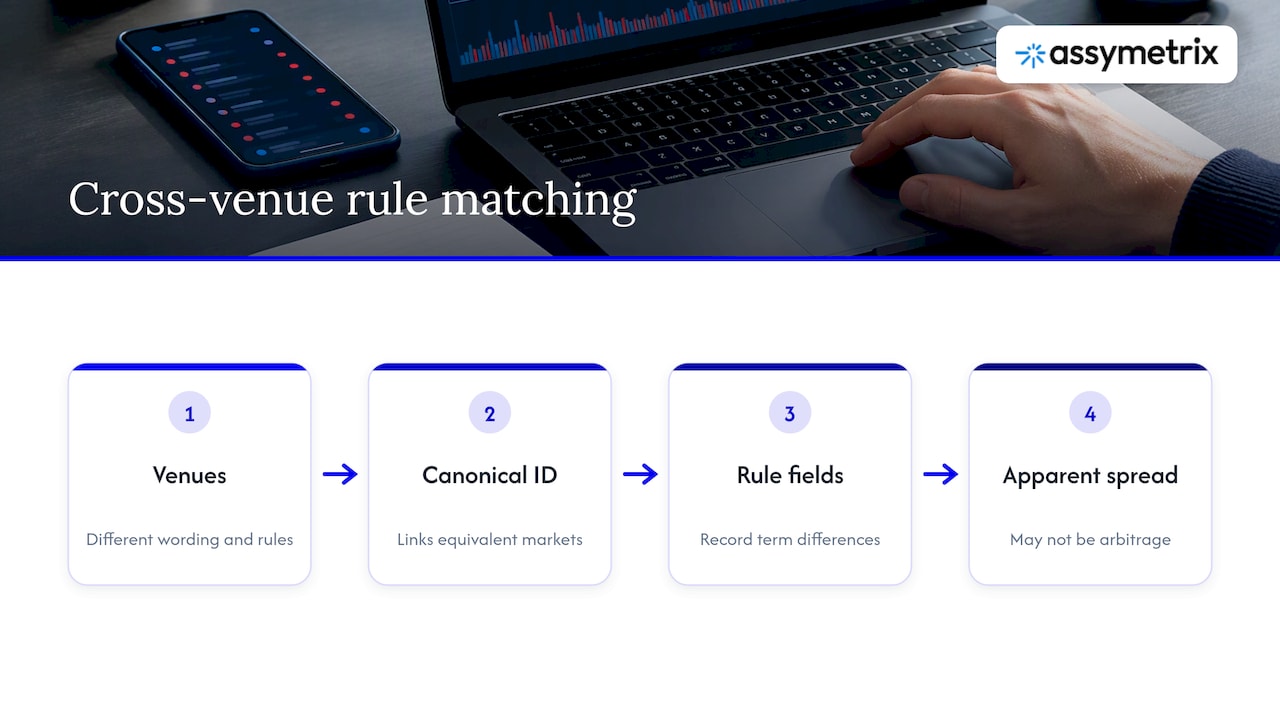
Pro Tip: Before entering any cross-venue position, verify resolution rule text word-for-word on both platforms. “Will the Fed cut rates?” can mean a 25bps cut on one venue and 50bps+ on another. That wording difference can turn a hedged position into a directional loss on both legs.

What data infrastructure does real-time arbitrage detection require?

Detecting cross-venue gaps before they close requires unified, low-latency price feeds from all three venues simultaneously. A fragmented setup, where you maintain separate API connections to Polymarket’s CLOB API, Kalshi’s REST API, and Limitless independently, introduces synchronization lag and schema inconsistencies that erode edge.

The Assymetrix Data API at data.assymetrix.com consolidates all three venues into a single integration. It normalizes market schemas across venues, delivers real-time order book depth, and surfaces cross-venue arbitrage signals directly, built on approximately 1.5 terabytes of historical data spanning nearly one billion rows of trading activity. That eliminates the engineering overhead of maintaining three separate connections with mismatched data formats.

Infrastructure Layer

Requirement

Why It Matters

Price feed

Sub-second cross-venue sync

Gaps close in seconds on liquid markets

Order book depth

Level 2 data per venue

Slippage estimation before order submission

Schema normalization

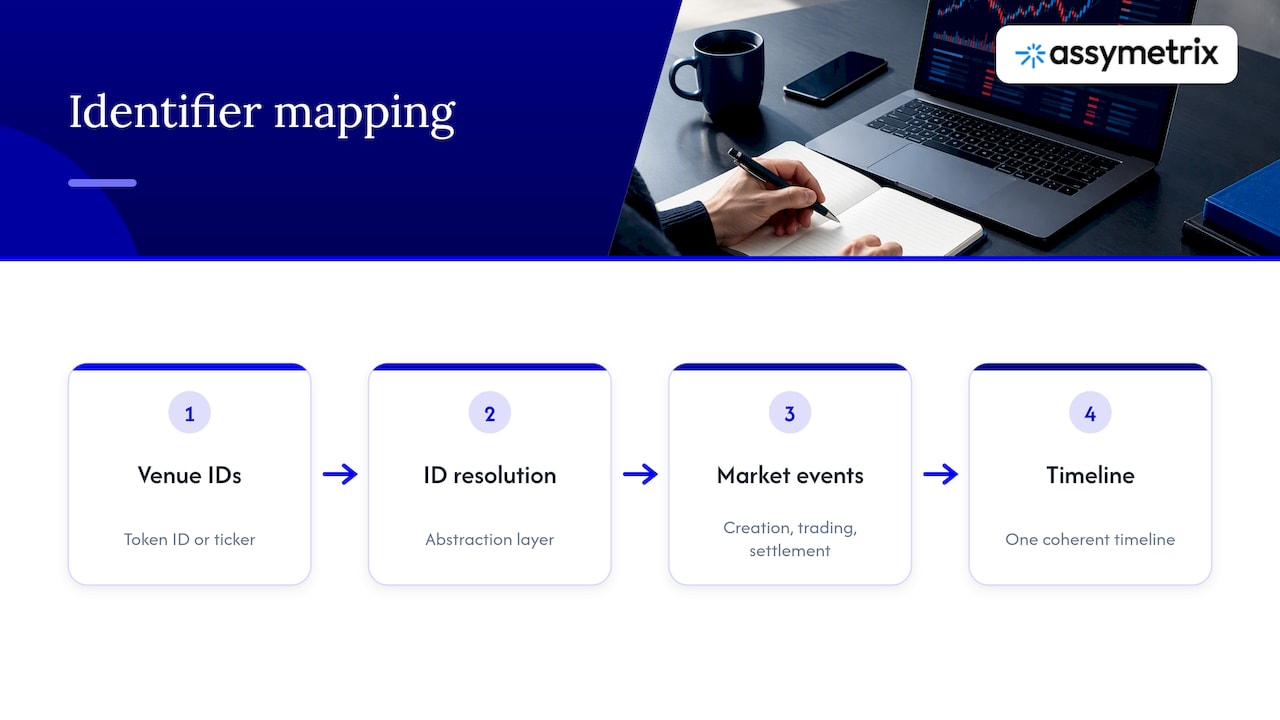
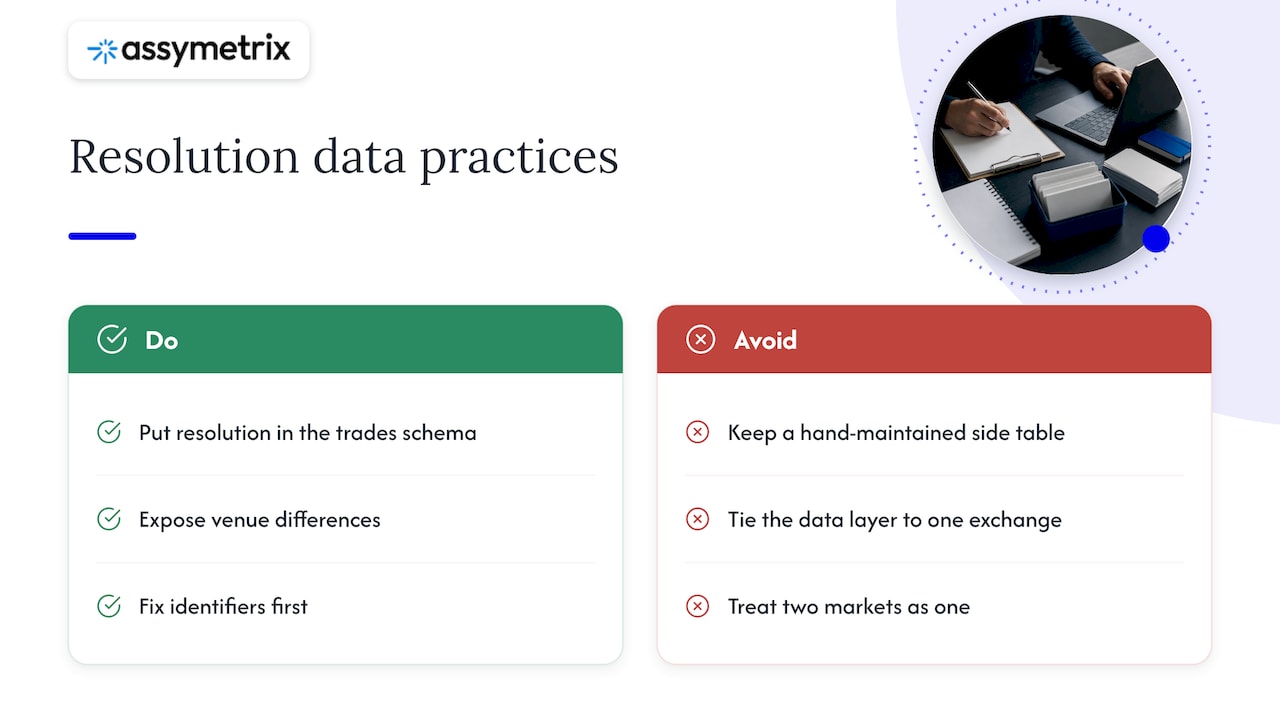
Unified market identifiers

Accurate event matching across venues

Historical data

Multi-year tick data

Backtesting and signal calibration

Alerting

Threshold-based triggers

Automated opportunity notification

For execution, automated bots dominate in 2026, squeezing opportunities that once lasted minutes into sub-second windows. A bot built on Node.js with TypeScript, connecting to Polymarket’s CLOB API via Polygon and Kalshi’s REST API, can place both legs in parallel within milliseconds of detection. The open-source CrossArb implementation on GitHub demonstrates this architecture, including leg-timeout logic that cancels and unwinds if one side fails to fill within five seconds.

Pro Tip: Set a minimum net spread threshold of at least 1.8% after fees before executing. Below that, estimation error and slippage make the trade a near-coinflip. The arbitrage scanner tutorial from Assymetrix walks through building this filter in under 30 minutes.

Execution constraints and risk management you cannot ignore

Slippage is the first cost most models underweight. Thin order books on Kalshi or Limitless can move the fill price by several cents between detection and execution, erasing a 2% gross edge entirely. Setting a minimum market volume threshold (the CrossArb reference config uses $5,000 USDC) filters out the markets most likely to gap on entry.

Position sizing follows fractional Kelly logic. Full Kelly maximizes long-run growth in theory but produces drawdowns that are operationally unacceptable. Traders use quarter-Kelly or half-Kelly to reduce variance while maintaining positive expected value deployment across a portfolio of concurrent arb positions.

Resolution risk is the single largest source of unexpected loss in prediction market arbitrage. Even contracts with identical ticker names can carry different resolution criteria, different data sources, and different edge-case definitions. In the worst case, both legs resolve against you. Professionals verify resolution rule text programmatically before every trade, not just at strategy design time.

The expected profit formula for a two-leg cross-venue arb:

Net Profit = (1 - YES_price - NO_price) - Fee_venue_A - Fee_venue_B - Slippage_A - Slippage_B

Partial fills introduce atomicity risk. If leg A fills and leg B fails, you hold a naked directional position. Proper execution logic attempts to resubmit the failed leg at current market price, then unwinds the filled leg at market if the resubmission fails, and alerts immediately via Telegram or Discord.

Capital lock-up is a structural constraint, not just a liquidity consideration. Both positions tie up capital until resolution. A 4% gross edge on a 90-day contract annualizes attractively, but compare it against the opportunity cost of capital deployed elsewhere before sizing up.

Historical performance and documented arbitrage cases

The most rigorous empirical record comes from on-chain Polymarket data. Researchers found $40 million in realized arbitrage profit extracted across intra-market rebalancing and combinatorial strategies during their measurement period. Within single conditions, buying below $1.00 and selling above $1.00 generated multimillion-dollar profits. Sports markets showed the highest frequency of opportunities, with politics markets generating larger but less frequent gaps, particularly around the 2024 election cycle.

Cross-venue gaps between Polymarket and Kalshi on high-profile events have historically produced substantial gross edges during volatile repricing windows, when the two venues update at different speeds.

Legal and ethical considerations

Kalshi operates as a CFTC-regulated derivatives exchange, available only to eligible US participants. Polymarket’s availability varies by jurisdiction, and US traders face restrictions. Verify your eligibility on both platforms before building any automated execution system.

Arbitrage itself is legal and structurally beneficial. It improves price efficiency across venues and tightens spreads over time. The ethical boundary is market manipulation, placing orders with no intent to fill, or coordinating to move prices artificially. Pure arbitrage, taking genuine opposing positions at posted prices, falls well outside that line.

Regulatory treatment of prediction market profits as taxable income applies in the US. Kalshi reports winnings; Polymarket’s on-chain settlement creates its own tax reporting obligations. Consult a tax professional familiar with derivatives and digital asset settlement.

Machine learning and quantitative models in arbitrage strategy development

ML integration in prediction market arbitrage falls into three practical categories. First, event matching: LLM-assisted heuristics reduce the search space for combinatorial arbitrage from exponential to tractable by identifying topically similar and mutually exclusive market pairs across venues. The Saguillo et al. study used this approach to make dependency graph analysis scalable across thousands of Polymarket conditions.

Second, spread prediction: gradient boosting models trained on historical order book data, event category, time to resolution, and venue-specific liquidity metrics can estimate the probability that a detected gap will persist long enough to execute both legs profitably. This feeds directly into pre-trade sizing decisions.

Third, resolution risk scoring: NLP classifiers trained on resolution rule text can flag contracts where wording diverges across venues, surfacing the highest-risk pairs before a trader commits capital. Backtesting these models against historical strategy data from Assymetrix’s API, which covers nearly one billion rows of trading activity, provides the sample size needed for statistically meaningful validation.

How Polymarket, Kalshi, and Limitless compare for arbitrage opportunities

Each venue has a distinct profile that shapes which strategies are viable.

Polymarket offers the deepest liquidity on political and macro markets, on-chain order book transparency, and the intra-market rebalancing and combinatorial arbitrage opportunities unique to its NegRisk architecture. The approximately 2% fee on net profits sets a low minimum edge threshold. On-chain execution requires gas and atomic tooling; partial fills create naked exposure risk.

Kalshi is CFTC-regulated, settles in USD, and carries a 7% winner fee that demands larger raw edges. Its resolution committee introduces timing uncertainty relative to Polymarket’s oracle. The venue’s strength is its regulatory clarity for US traders and its growing liquidity on economic indicator markets. The 2026 platform landscape shows Kalshi expanding its market catalog aggressively, which increases cross-venue overlap with Polymarket.

Limitless adds a third data point for cross-venue scanning. Its liquidity profile differs from both Polymarket and Kalshi, creating occasional three-way pricing inconsistencies that two-venue scanners miss entirely. For traders running unified feeds through the Assymetrix Data API, Limitless coverage is included without additional integration work.

Fast execution hardware matters as much as software latency. For traders where milliseconds determine fill quality, execution speed at the hardware level is a real variable in the arbitrage stack.

How market liquidity and volume affect arbitrage feasibility

Liquidity is the gating variable for every arbitrage strategy. A 4% gross edge on a market with $500 in open interest is not executable at meaningful size without moving the price against yourself. The CrossArb reference configuration filters out markets below $5,000 USDC in volume for exactly this reason.

Thin markets also produce wider bid-ask spreads, which eat directly into the gross edge before fees are even applied. Sports markets on Polymarket show high frequency of rebalancing opportunities precisely because fast-moving odds create frequent mispricings, but the individual opportunity sizes are smaller. Politics markets have fewer but larger gaps, particularly during volatile periods when market makers lag repricing.

Volume concentration matters for timing. High-volatility events, election nights, surprise Fed decisions, major economic data releases, consistently produce the widest cross-venue spreads because the two venues reprice at different speeds. Monitoring volume spikes in real time, which the Assymetrix Data API surfaces as part of its market divergence intelligence layer, lets you position scanning resources where gaps are most likely to appear.

Key Takeaways

Prediction market arbitrage is executable in 2026, but only with unified data infrastructure, fee-aware sizing, and rigorous resolution risk analysis before every trade.

Point

Details

Core condition

Buy YES and NO across venues when combined cost is below $1.00, guaranteeing pre-fee profit.

Fee thresholds

Kalshi’s 7% winner fee requires roughly 3% raw edge; Polymarket’s ~2% fee sets the bar near 1.5%.

Resolution risk

Contracts with identical names can resolve differently across venues, causing losses on both legs.

Realized scale

On-chain research found $40 million in extracted arbitrage profit on Polymarket during the study period.

Data infrastructure

Unified cross-venue feeds via the Assymetrix Data API eliminate schema mismatches and synchronization lag.

FAQ

Is it possible to arbitrage prediction markets?

Yes. When the sum of the cheapest YES on one venue and the cheapest NO on another falls below $1.00, a guaranteed pre-fee profit exists. On-chain research documented $40 million in realized arbitrage profit on Polymarket alone.

Is prediction market arbitrage legal?

Cross-venue arbitrage is legal. Kalshi is CFTC-regulated and available to eligible US participants; Polymarket’s availability varies by jurisdiction. Verify your eligibility before building automated execution systems.

Can you realistically profit from prediction market arbitrage?

Yes, with the right infrastructure. Cross-venue trades typically present gross edges in the low single-digit percentage range per position, but Kalshi’s 7% winner fee and slippage on thin order books can eliminate net profit on smaller edges. Fractional Kelly sizing and a minimum net spread threshold of at least 1.8% after fees are standard risk controls.

How does resolution risk affect arbitrage trades?

Resolution risk is the primary source of unexpected loss. Polymarket uses UMA’s optimistic oracle; Kalshi uses an internal committee. The same real-world event can resolve differently on each platform, turning a hedged position into a loss on both legs. Always verify resolution rule text on both venues before entering a position.

What data tools do quantitative traders use for cross-venue arbitrage?

The Assymetrix Data API at data.assymetrix.com provides unified real-time and historical data across Polymarket, Kalshi, and Limitless through a single integration, with normalized schemas and built-in cross-venue arbitrage signals.

How AI Agents Use Prediction Market Data to Trade Autonomously

How AI Agents Use Prediction Market Data to Trade Autonomously

TL;DR:

  • Autonomous AI trading agents analyze real-time prediction market data to execute trades without human input. They leverage cross-venue signals, probabilistic models, and whale trade detection, enhanced by dedicated architecture separating data ingestion, analysis, and execution. Reliable, unified data like that from Assymetrix is crucial for building effective and risk-managed AI trading systems.

Autonomous AI trading agents are defined as software systems that ingest real-time market signals, score event probabilities, and execute trades without human intervention. Prediction markets are the ideal data source for these agents because every contract resolves to a binary outcome, prices reflect crowd-aggregated probability estimates, and liquidity is continuous and verifiable. Prediction markets exceeded $23.8 billion in annual trading volume by Q2 2026, confirming that the asset class is large enough to support institutional-grade autonomous systems. The core mechanism is straightforward: an agent computes its own probability estimate for an event, compares that estimate to the current on-chain share price, and executes a trade when the gap exceeds a defined threshold.

How AI agents use prediction market data to trade autonomously

AI agents identify trading opportunities by scoring probabilities internally and comparing those scores to on-chain market prices. When the agent’s internal estimate diverges from the live share price by more than a calibrated margin, it triggers a buy or sell order through a smart contract interface. This approach converts prediction market data into a continuous stream of probability-weighted signals rather than discrete news events. The result is a system that reacts to market inefficiencies in milliseconds, without waiting for analyst review.

Prediction markets are structurally better suited to AI agents than traditional financial markets for three reasons. First, every contract has a defined resolution criterion, so the agent always knows what outcome it is pricing. Second, prices are expressed as probabilities between 0 and 1, which maps directly onto the output of probabilistic models. Third, cross-venue data from platforms like Polymarket, Kalshi, and Limitless creates arbitrage opportunities that a fast agent can capture before prices converge.

What prediction market data inputs are essential for AI trading agents?

An AI trading agent requires multiple data streams to form a reliable trading decision. A single price feed is not sufficient. The agent needs order book depth, volume history, resolution metadata, and wallet-level signals to distinguish genuine market moves from noise.

The core data inputs fall into five categories:

  • Real-time price feeds: Bid price, ask price, last trade price, and mid-market price updated on every block or tick. These form the baseline against which the agent’s internal probability estimate is compared.

  • Order book depth and liquidity summaries: The full depth of resting orders at each price level. Thin order books signal low conviction; deep books signal that informed participants have committed capital.

  • Whale trade data: Large trades above the whale threshold of $8,000 per transaction are flagged as high-signal events. A single large trade can shift the market-implied probability by several percentage points.

  • Historical resolution outcomes: Resolved contract data is the ground truth for model calibration. Agents trained on resolution histories learn which market conditions produce accurate prices and which produce persistent mispricings.

  • Cross-venue aggregated data: Prices for the same event often differ across Polymarket, Kalshi, and Limitless. Aggregating these feeds exposes arbitrage spreads that a single-venue agent cannot see.

The table below maps each data input to its primary function in the agent’s decision pipeline.

Data Input

Primary Function

Real-time price feed

Baseline probability comparison

Order book depth

Liquidity and conviction assessment

Whale trade signals

High-confidence directional trigger

Historical resolution data

Model calibration and backtesting

Cross-venue aggregated feed

Arbitrage and divergence detection

Pro Tip: Index whale trades by wallet address across venues. A wallet that consistently profits before resolution is a stronger signal than raw trade size alone.

How does the Assymetrix Data API enable unified cross-venue data integration?

Assymetrix provides a single API endpoint that delivers consolidated data from Polymarket, Kalshi, and Limitless under one standardized schema. For an AI agent developer, this eliminates the engineering cost of maintaining three separate data pipelines with different authentication systems, rate limits, and data formats. The Assymetrix Data API at data.assymetrix.com is built on nearly one billion indexed rows of cross-venue trading activity, giving agents access to a historical depth that most single-venue feeds cannot match.

The platform’s unified data schema normalizes fields like contract ID, resolution criteria, price, volume, and wallet address across all three venues. An agent can query the same endpoint for a Polymarket election contract and a Kalshi economic contract without writing venue-specific parsing logic. That consistency matters at inference time, when the agent must process hundreds of contracts per second.

Key capabilities the Assymetrix API surfaces for autonomous agents include:

  • Smart Money wallet tracking: Identifies wallets with statistically significant win rates, allowing agents to weight their signals more heavily than anonymous retail flow.

  • Trader Skill Scores: Quantitative ratings assigned to individual wallets based on historical performance, enabling the agent to filter noise from informed order flow.

  • Cross-venue arbitrage signals: Pre-computed divergence alerts when the same event trades at materially different prices across venues.

  • Market divergence intelligence: Flags when a market’s implied probability deviates from consensus across venues, signaling a potential mispricing.

Pro Tip: Use the historical resolution dataset for backtesting prediction market strategies before deploying any live agent. A model that looks profitable on paper often fails when tested against actual resolution outcomes.

What AI strategies detect trading opportunities and execute autonomously?

The most effective autonomous trading strategies combine probabilistic scoring, arbitrage detection, and Smart Money signal incorporation into a single decision pipeline. Each layer filters the signal before the agent commits capital.

  1. Probability scoring: The agent runs its own forecasting model, typically a calibrated classifier trained on historical resolution data. Autonomous trading engines calibrated via hierarchical maximum-likelihood estimation have been tested on 291,309 resolved binary contracts to optimize pricing accuracy. The agent compares its output probability to the current market price and sizes positions proportionally to the confidence gap.

  2. Arbitrage detection: When the same event trades at different prices across Polymarket, Kalshi, and Limitless, the agent computes a risk-adjusted spread. A cross-venue arbitrage scanner using constraint-based algorithms can identify and rank these spreads in real time. The agent executes both legs simultaneously to lock in the spread before prices converge.

  3. Smart Money signal incorporation: Smart Money detection involves monitoring large trades, volume spikes, and liquidity changes across venues to identify market-moving participants before prices fully reflect their information. When a tracked wallet places a large directional bet, the agent treats this as a Bayesian update to its own probability estimate.

  4. Sequential belief updating: AI agents must continuously update probabilistic models in real time. Failure to reassess fair value after new information leads to stale trading decisions. The agent re-runs its scoring model on every new price tick, resolution event, or whale trade.

  5. Validation gating: No trade executes without passing a quantitative risk check. Position size limits, maximum drawdown thresholds, and liquidity minimums act as hard constraints. This gate prevents the agent from acting on model outputs that are technically valid but operationally unsafe.

A multi-agent debate architecture, where separate analyst AIs argue for and against a trade before a designated orchestrator executes the validated consensus, reduces hallucination risk and exposes confirmation bias that single-model systems miss. LLMs serve best as analysts proposing hypotheses; only the orchestrator module, after quantitative validation, should touch the execution layer.

Pro Tip: Never let an LLM output trigger a trade directly. Route all LLM-generated hypotheses through an independent quantitative verification module before execution.

How to design an autonomous AI agent architecture for prediction market trading

A production-grade autonomous agent separates data ingestion, analysis, and execution into distinct layers. Coupling these layers tightly creates a single point of failure. Real-time data ingestion layers should be decoupled from analysis nodes to maintain feed reliability and reduce decision latency.

The recommended architecture follows four layers:

  • Ingestion layer: Pulls real-time and historical data from the Assymetrix API, normalizes it to a consistent schema, and writes it to an in-memory store. This layer runs independently of the analysis layer so that a model crash does not interrupt data collection.

  • Analytical ensemble: A set of models, including a calibrated probability scorer, an arbitrage detector, and a Smart Money signal processor, that each produce a trade hypothesis. A multi-agent adversarial debate architecture then pits these hypotheses against each other to surface the highest-confidence signal.

  • Orchestrator node: Receives the validated hypothesis from the ensemble, applies risk management constraints, and executes the trade through a smart contract interface. Combining off-chain AI computing with on-chain smart contracts through a secure orchestration layer enables reliable autonomous execution.

  • Feedback loop: Resolved contracts feed back into the calibration dataset. The agent’s probability models update continuously as new ground truth becomes available.

The table below maps each architectural layer to its primary responsibility and failure mode.

Layer

Responsibility

Primary failure mode

Ingestion

Data collection and normalization

Stale or missing feeds

Analytical ensemble

Hypothesis generation and debate

Confirmation bias in single-model output

Orchestrator

Validated trade execution

Unconstrained position sizing

Feedback loop

Model recalibration

Delayed or missing resolution data

Human-in-the-loop gating is the right default for the first weeks of live deployment. Gradually remove manual approval as the agent’s track record on paper trades builds confidence in its risk management behavior.

Key takeaways

Autonomous AI agents trade prediction markets profitably by combining real-time cross-venue data, calibrated probabilistic models, Smart Money signal detection, and strict validation gating before any trade executes.

Point

Details

Binary outcomes enable precise modeling

Prediction market contracts resolve to 0 or 1, mapping directly onto probability classifier outputs.

Cross-venue data exposes arbitrage

Aggregating Polymarket, Kalshi, and Limitless feeds reveals price divergences a single-venue agent cannot detect.

Smart Money signals improve timing

Tracking whale wallets above the $8,000 threshold provides early directional signals before prices fully adjust.

Decoupled architecture reduces failure risk

Separating ingestion, analysis, and execution layers prevents a model crash from halting data collection.

Validation gating is non-negotiable

Every LLM-generated hypothesis must pass a quantitative risk check before the orchestrator executes a trade.

What I’ve learned building with prediction market data

The biggest mistake I see developers make is treating the LLM as the trading brain. It is not. An LLM is a hypothesis generator. The moment you let it touch execution directly, you have introduced a hallucination vector into a system where errors cost real money. The correct architecture keeps the LLM in the analyst seat and puts a deterministic quantitative module in the orchestrator seat.

The second mistake is underinvesting in the data layer. Stale feeds are more dangerous than no feeds, because the agent acts on information it believes is current. A decoupled ingestion layer with health checks and automatic failover is not optional infrastructure. It is the foundation everything else depends on.

Smart Money signals are genuinely underused. Most developers focus on price and volume and ignore wallet-level data entirely. In my experience, a tracked wallet placing a large bet on a low-liquidity contract is one of the strongest leading indicators available in prediction markets. Assymetrix surfaces this signal directly through its Smart Money wallet tracking layer, which saves weeks of custom pipeline work.

The path forward for this space is multi-agent debate architectures running continuously across dozens of contracts, with orchestrators that manage portfolio-level risk rather than single-trade risk. That requires unified, reliable data at scale. Developers who build on fragmented single-venue feeds will hit a ceiling quickly.

— Dean

Assymetrix: unified prediction market data for AI agent developers

Building a reliable autonomous trading agent starts with reliable data. Assymetrix aggregates real-time and historical feeds from Polymarket, Kalshi, and Limitless into a single API endpoint, backed by nearly one billion indexed rows of cross-venue trading activity.


The Assymetrix platform surfaces Smart Money wallet tracking, Trader Skill Scores, cross-venue arbitrage signals, and market divergence intelligence through one integration. Developers get a standardized schema, deep historical data for backtesting, and live signals that feed directly into autonomous agent decision pipelines. If you are building an AI agent that needs structured, cross-venue prediction market data at scale, the Assymetrix Data API at data.assymetrix.com is the integration point your architecture needs.

FAQ

What makes prediction markets better data sources for AI agents than traditional markets?

Prediction markets resolve to binary outcomes with defined criteria, so an AI agent always knows exactly what it is pricing. This maps directly onto probabilistic classifier outputs in a way that continuous price series from equity or FX markets do not.

What is the whale trade threshold used in prediction market signal detection?

Developers using structured prediction market data protocols flag trades at or above $8,000 as whale trades. These large transactions carry significantly more directional information than retail-sized orders.

How many resolved contracts are available for backtesting AI trading models?

Calibration datasets for autonomous trading engines have been built on over 291,000 resolved binary contracts. That volume provides statistically meaningful ground truth for training and validating probability scoring models.

Why should the LLM be separated from trade execution in an autonomous agent?

LLMs generate hypotheses but can hallucinate or misweight probabilistic outcomes. The top failure mode in autonomous trading systems is trusting LLM outputs directly. A dedicated orchestrator module with independent quantitative validation must gate all trade executions.

How does cross-venue data aggregation improve autonomous trading performance?

The same event often trades at different implied probabilities across Polymarket, Kalshi, and Limitless. An agent with access to cross-venue prediction market data can detect and execute on these spreads before prices converge, capturing risk-adjusted returns unavailable to single-venue agents.