Developers & Quants: Ship Sports Prediction Market Pipelines with Canonical IDs
Developers & Quants: Ship Sports Prediction Market Pipelines with Canonical IDs
Developers & Quants: Ship Sports Prediction Market Pipelines with Canonical IDs
Unified API and hands on integration patterns for production sports prediction market trading. Canonical IDs, REST and WebSocket workflows, and normalized...

Developers & Quants: Ship Sports Prediction Market Pipelines with Canonical IDs
A unified prediction market data API delivers normalized live odds, order-book snapshots, canonical market IDs, and historical price data through one integration instead of three separate venue feeds. That consolidation cuts settlement mismatches, standardizes arbitrage and smart-money signals across venues, and shortens the path from backtest to live execution. The Data API was built to address this problem for sports traders working across multiple prediction market venues.
TL;DR:
Cross-venue normalization with canonical IDs is essential for reliable arbitrage detection and accurate cross-market analysis.
The API provides real-time order book snapshots, trade history, and settlement metadata, supporting both REST and streaming data flows for various trading needs.
Effective management of sequence IDs and regular snapshot reconciliation is critical to prevent silent drift and ensure accurate market state during live trading.
Prediction markets encompass diverse assets like binary outcomes, point spreads, futures, and in-game markets, all with differing settlement criteria that must be explicitly handled.
Building a production pipeline requires staged deployment, strict validation of settlement data, and careful handling of market status and resolution rules to avoid costly errors.
Assymetrixassymetrix.comBuild With Unified Market DataAssymetrix gives developers and quants unified access to cross venue prediction market data through a single Data API integration.Explore the Data API
Table of Contents
What Does a Prediction Market Data API for Sports Trading Include?
How Do Sports Prediction Market Order Books Actually Work?
Why Do Canonical IDs Matter for Cross-Venue Sports Data?
What Sports Markets Are Available and How Do They Differ From Sportsbooks?
How Do You Build a Production Sports Data Ingestion Pipeline?
What Can You Build With Sports Prediction Market Data?
Assymetrix Developer Resources for Sports Data Integration
What Actually Matters When You Move to Production
Get Started With the Assymetrix Data API
Primary Sources for Regulatory and Developer Reference
Sources
What Does a Prediction Market Data API for Sports Trading Include?
A production-grade API surface for sports prediction markets needs to answer seven questions: what markets exist, what are they trading at, who’s trading them, what does the book look like, how did price move historically, what are these teams/players/fixtures, and how does this market resolve. That maps to a specific set of endpoints.
/markets— active and historical market metadata, including sport, league, and market type/quotes— current best bid/ask and implied probability for a given market/trades— executed trade history with price, size, and timestamp/order_book— full depth snapshot showing resting orders on both sides/candles— OHLCV bars for model inputs and charting/reference— canonical team, player, and fixture identifiers/settlement-metadata— resolution source, status, and settlement rules for a given market
The choice between pulling data and streaming it depends on the job. REST pull works for snapshots, backfill, and anything that doesn’t need sub-second freshness, like nightly model retraining or building a historical database. WebSocket or Server-Sent Events streaming is the right call for anything execution-facing: market-making bots, live arbitrage detection, in-game prop trading. Bulk exports exist for a third case entirely, backtesting against months or years of tick-level history without hammering a REST endpoint thousands of times.
Authentication typically runs on scoped API keys, with separate tokens for read-only research access versus higher-throughput trading access. Rate-limit handling matters more than most developers assume going in: implement exponential backoff on 429 responses, rotate tokens across parallel workers, and size your polling windows to the venue’s actual update frequency rather than polling as fast as the limit allows. A hybrid pattern works best in practice: REST for historical backfill and reference data, WebSocket for live market state. Analytics workloads can tolerate a few seconds of staleness; execution workloads need an uptime SLA closer to real time, with reconnection logic that assumes the stream will drop.
How Do Sports Prediction Market Order Books Actually Work?
Sports prediction markets trade like limit order books, not like a sportsbook’s fixed line. Every quote you see is a resting order somebody placed, and every trade moves the book. Developers coming from traditional sportsbook data feeds need to unlearn the assumption of a single “line” and start thinking in book depth.
The standard order-book payload includes price, size, side (bid or ask), a sequence ID, and a timestamp. Two delivery patterns show up across venues: full snapshots and incremental deltas. A snapshot gives you the entire book at a point in time; a delta tells you what changed since the last sequence ID. Getting this wrong, applying deltas out of order or missing one, is the single most common cause of a bot trading against a book state that no longer exists.
Subscribe to the market’s book channel and request an initial full snapshot.
Buffer incoming deltas until the snapshot arrives, then apply them in sequence order.
Track the sequence ID on every message; if you detect a gap, discard local state and request a fresh snapshot.
Reconcile trade-stream prints against book-implied prices to catch silent drift.
Aggregate ticks into OHLCV candles on whatever cadence your strategy needs, seconds for live trading, minutes or hours for research.
Live trading systems should reconcile book state against a fresh snapshot every few minutes regardless of sequence ID continuity, because silent drift from a missed edge case is worse than a detected gap.
Pro Tip: Run a checksum comparison between your locally maintained book and a fresh REST snapshot on a fixed interval, even when your sequence IDs look clean. Drift that never triggers a gap detection is the kind that costs money.
Why Do Canonical IDs Matter for Cross-Venue Sports Data?
Without canonical IDs, a “Chiefs vs. Bills moneyline” market on one venue and the functionally identical contract on another look like two unrelated data points. That breaks deduplication, breaks historical joins across seasons, and makes cross-venue arbitrage detection close to impossible to automate reliably. Assymetrix’s normalization guide treats canonical IDs as the foundation layer everything else in a trading system sits on.
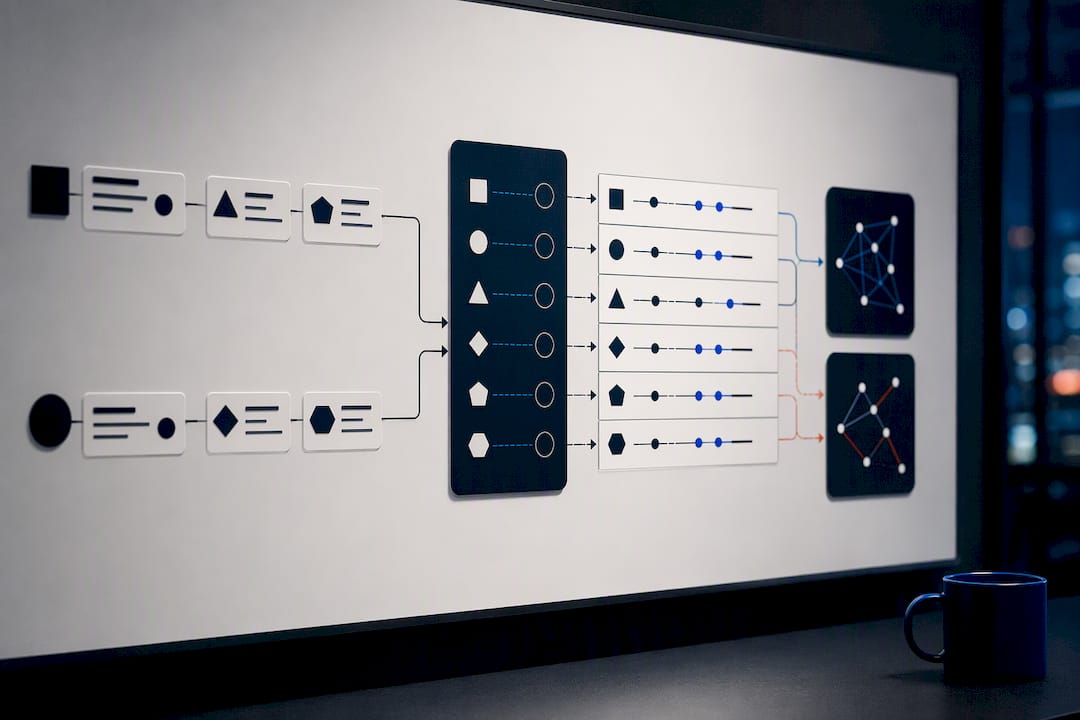
Settlement rules are where this gets genuinely tricky in sports specifically. One venue might resolve a market at the end of regulation time; another resolves the same nominal event including overtime. A market listed as “will Team X win” can carry entirely different resolution criteria depending on the venue’s contract language, and the CFTC’s guidance on event contracts stresses that objective, clearly defined settlement sources are core to how these products are supposed to work.
Practical normalization requires:
Mapping every exchange-native market ID to a stable canonical ID at ingestion time
Encoding the settlement source and resolution window explicitly, not inferring it from the market title
Handling market splits and merges, a spread market that later gets offered as converted binary sub-markets, without losing the parent-child relationship
Gating execution on market-status flags so a bot never trades into a market that’s already resolving
Before any order goes out, run three checks: settlement-source metadata is present and non-null, timestamps are normalized to a single timezone, and the market status confirms the contract is still actively trading. Skipping any one of those checks is how automated systems end up executing against stale or already-settled markets.
What Sports Markets Are Available and How Do They Differ From Sportsbooks?
Sports prediction markets cover more ground than a quick glance suggests. You’ll find binary game-outcome contracts, point spreads, totals, player props, season-long futures, multi-outcome tournament winners, and, on the more advanced venues, live in-game markets that reprice continuously as the event unfolds.
The structural difference from sportsbook data is the part that actually matters for strategy design. A sportsbook sets a house line and adjusts it to balance its own book. A prediction market has no house line at all: price is whatever the crowd is willing to pay, discovered through an order book the same way a stock or futures contract trades. Fidelity’s primer on prediction markets describes this as pricing by implied probability rather than fixed odds, and on venues like Polymarket that entire trade history sits on-chain and is publicly auditable, something no sportsbook feed offers.
Binary outcomes and spreads settle against final scores; futures settle against tournament or season results
Player props typically settle against official box-score statistics, so contract design should specify which stat source governs resolution
Live in-game markets carry tighter latency requirements because price moves with every scoring event
Always check a market’s settlement metadata before treating it as tradeable, some sports contract categories carry ongoing regulatory scrutiny over resolution criteria, particularly around officiating decisions or injury-dependent outcomes, a distinction recent proposed CFTC rulemaking addresses directly
How Do You Build a Production Sports Data Ingestion Pipeline?
A working pipeline for sports prediction market data follows a consistent shape regardless of which venues you’re pulling from: streaming ingestion feeds an in-memory order-book state, a normalization layer maps that state to canonical schema, a signal engine computes derived metrics, and an execution gateway acts on them. Keeping these layers separate makes it possible to backtest the signal engine against historical data without touching the execution layer at all.
Connect and authorize. Open a WebSocket connection using your scoped API key and confirm the handshake before subscribing to anything.
Subscribe to market topics. Request the specific canonical market IDs or sport/league channels relevant to your strategy rather than subscribing to the full firehose.
Apply snapshot plus deltas. Request an initial book snapshot, buffer incoming messages until it arrives, then apply deltas in sequence order.
Detect and recover gaps. Watch sequence IDs continuously; on any gap, drop local state and re-request a snapshot rather than trying to patch around it.
Persist to a time-series store. Write normalized ticks and book snapshots to a database built for time-series workloads, this is what your backtests and model training will query later.
Backfill with REST. For anything predating your streaming connection, pull historical data through the REST API or a bulk export rather than trying to reconstruct it from partial logs.
Reconcile daily. Replay a window of persisted sequence IDs against a fresh venue snapshot to confirm your stored state matches reality.
For REST-based historical work specifically, bulk export is the better tool once you’re pulling more than a few days of tick history, a paginated REST loop against months of trade data wastes both your rate limit and your engineering time. The Assymetrix Python developer guide walks through runnable examples for both the streaming and backfill paths, which is the fastest way to get a working prototype before you invest in your own reconnection and reconciliation logic.
Idempotent writes matter more here than in most data pipelines, because a reconnection after a dropped WebSocket session will often replay messages you already processed. Key your persistence layer on the sequence ID and market ID together, so a duplicate message is a no-op instead of a corrupted book state.
Pro Tip: When replaying a reconciliation window, always pull from a safe checkpoint at least a few minutes before your last confirmed good state, not the exact last timestamp. Sequence gaps rarely announce themselves cleanly at the boundary.
What Can You Build With Sports Prediction Market Data?
The raw feed is the input. What you build on top of it is where the actual edge lives.
Market-making strategies lean on order-book depth and spread dynamics: quote inside the resting spread when depth is thin, widen out when volatility spikes around a scoring event, and model expected slippage before sizing an order rather than after it fills badly. Cross-venue arbitrage works by detecting price divergence between the same canonical market on two venues and routing execution to capture the spread, but only after netting out venue fees and confirming both sides resolve under the same settlement rules. A divergence that looks like free money often isn’t, once you account for a settlement-timing mismatch between venues.
Smart-money detection is where volume-based signals tend to mislead developers new to the space. Raw trading volume tells you activity happened, not whether it was informed. Assymetrix’s Smart Money tracking weights wallet-level profit consistency and trade cadence over headline volume, because a wallet with a modest but persistent profit factor across multiple time windows is a stronger signal than a single large, one-off trade.
Compute profit-factor across several time windows to filter transient whale noise from genuine skill
Feed order-flow imbalance and time-series price features into ML models rather than raw prices alone
Treat wallet-based conviction metrics as a separate feature class from price-based technicals
Validate every backtest against out-of-sample data before sizing a live strategy against it
Feature engineering for AI agents and ML models generally combines three layers: price and order-flow time series, wallet-level behavioral signals, and settlement/resolution metadata as a categorical feature. Partner resources like BetsyScore’s analysis of AI football predictions offer a useful outside reference for how probability outputs get validated against realized outcomes in a sports-specific context.
Assymetrix Developer Resources for Sports Data Integration
This Data API aggregates cross-venue trading history going back several years, built on a large volume of historical data spanning multiple prediction market venues. That depth matters for backtesting sports strategies against multiple full seasons rather than a handful of months.
Beyond raw market data, the platform surfaces intelligence layers most raw venue APIs don’t expose natively:
Smart Money tracking — wallet-level profit and conviction metrics, not just volume
Trader Skill Scores — a ranking of wallet performance over time, useful for weighting copy-trading or signal inputs
Cross-venue arbitrage signals — pre-computed divergence detection across normalized canonical markets
Market divergence intelligence — flags where a market’s implied probability has diverged meaningfully from a correlated market elsewhere
For hands-on integration, start with the Assymetrix Data API reference for endpoint schemas and authentication, then move to the Python developer guide for runnable code, and the canonical ID guide if you’re building cross-venue logic from scratch. Resources specific to Polymarket’s on-chain data are available at data.assymetrix.com/polymarket.
What Actually Matters When You Move to Production
Chasing microsecond latency before your settlement-rule mapping is correct is a common early mistake. A fast bot trading against wrong resolution assumptions loses money faster than a slower one trading correctly.
Roll out in stages: sandbox ingestion first, then backtest validation against historical data, then a limited live deployment with small position sizes, then full production. Treat any of these as a hard stop: settlement metadata missing on a market you’re about to trade, a sequence gap you can’t explain, or a backtest Sharpe ratio that doesn’t survive out-of-sample testing. None of those are edge cases worth pushing through under deadline pressure.
— Dean
Get Started With the Assymetrix Data API
This service provides sports traders and developers a unified schema across major venues, with stable canonical IDs and extended historical coverage already normalized.
Building your own normalization layer across venues means reconciling different settlement conventions, different ID formats, and different book update semantics before you’ve written a single line of strategy code. The Assymetrix Data API skips that step: REST and WebSocket access to real-time and historical sports prediction market data through a single integration, with the same schema whether you’re pulling a game outcome, a player prop, or a tournament futures market. Pricing for the Data API is available directly on the product page, with commercial and academic access tiers to match how you’re using the data. If you’re building a trading bot, a research pipeline, or an AI agent that needs clean prediction market inputs, the fastest way to see whether it fits your stack is to pull up the API documentation and get an API key.
Primary Sources for Regulatory and Developer Reference
Assymetrix Data API reference
Sources
FAQ
What Prediction Markets Have APIs?
Polymarket and Kalshi both expose market data that developers can access, though schemas, authentication, and rate limits differ between them. The Assymetrix Data API normalizes both venues, plus Limitless, into a single schema so you don’t maintain three separate integrations.
Is There a Sports Data API Available?
Yes, several venues and aggregators offer sports-specific prediction market data covering game outcomes, player props, and futures. Assymetrix’s API specifically normalizes sports markets across Polymarket and Kalshi with consistent canonical IDs and historical data back to September 2020.
Is There a Google API for Sports Data?
Google doesn’t offer a dedicated prediction market or sportsbook data API; sports data typically comes from specialized providers or the exchange venues themselves. For prediction market specific data, including order books and settlement metadata, developers generally need a provider built for that market structure rather than a general search or cloud API.
What Is the Best Prediction Market for Sports?
Polymarket and Kalshi are the two dominant venues for sports-related event contracts in the U.S., each with different settlement conventions and market structures. Rather than picking one, most trading systems benefit from aggregating both through a single normalized feed like Assymetrix to compare pricing and catch cross-venue divergence.
Developers & Quants: Ship Sports Prediction Market Pipelines with Canonical IDs
A unified prediction market data API delivers normalized live odds, order-book snapshots, canonical market IDs, and historical price data through one integration instead of three separate venue feeds. That consolidation cuts settlement mismatches, standardizes arbitrage and smart-money signals across venues, and shortens the path from backtest to live execution. The Data API was built to address this problem for sports traders working across multiple prediction market venues.
TL;DR:
Cross-venue normalization with canonical IDs is essential for reliable arbitrage detection and accurate cross-market analysis.
The API provides real-time order book snapshots, trade history, and settlement metadata, supporting both REST and streaming data flows for various trading needs.
Effective management of sequence IDs and regular snapshot reconciliation is critical to prevent silent drift and ensure accurate market state during live trading.
Prediction markets encompass diverse assets like binary outcomes, point spreads, futures, and in-game markets, all with differing settlement criteria that must be explicitly handled.
Building a production pipeline requires staged deployment, strict validation of settlement data, and careful handling of market status and resolution rules to avoid costly errors.
Assymetrixassymetrix.comBuild With Unified Market DataAssymetrix gives developers and quants unified access to cross venue prediction market data through a single Data API integration.Explore the Data API
Table of Contents
What Does a Prediction Market Data API for Sports Trading Include?
How Do Sports Prediction Market Order Books Actually Work?
Why Do Canonical IDs Matter for Cross-Venue Sports Data?
What Sports Markets Are Available and How Do They Differ From Sportsbooks?
How Do You Build a Production Sports Data Ingestion Pipeline?
What Can You Build With Sports Prediction Market Data?
Assymetrix Developer Resources for Sports Data Integration
What Actually Matters When You Move to Production
Get Started With the Assymetrix Data API
Primary Sources for Regulatory and Developer Reference
Sources
What Does a Prediction Market Data API for Sports Trading Include?
A production-grade API surface for sports prediction markets needs to answer seven questions: what markets exist, what are they trading at, who’s trading them, what does the book look like, how did price move historically, what are these teams/players/fixtures, and how does this market resolve. That maps to a specific set of endpoints.
/markets— active and historical market metadata, including sport, league, and market type/quotes— current best bid/ask and implied probability for a given market/trades— executed trade history with price, size, and timestamp/order_book— full depth snapshot showing resting orders on both sides/candles— OHLCV bars for model inputs and charting/reference— canonical team, player, and fixture identifiers/settlement-metadata— resolution source, status, and settlement rules for a given market
The choice between pulling data and streaming it depends on the job. REST pull works for snapshots, backfill, and anything that doesn’t need sub-second freshness, like nightly model retraining or building a historical database. WebSocket or Server-Sent Events streaming is the right call for anything execution-facing: market-making bots, live arbitrage detection, in-game prop trading. Bulk exports exist for a third case entirely, backtesting against months or years of tick-level history without hammering a REST endpoint thousands of times.
Authentication typically runs on scoped API keys, with separate tokens for read-only research access versus higher-throughput trading access. Rate-limit handling matters more than most developers assume going in: implement exponential backoff on 429 responses, rotate tokens across parallel workers, and size your polling windows to the venue’s actual update frequency rather than polling as fast as the limit allows. A hybrid pattern works best in practice: REST for historical backfill and reference data, WebSocket for live market state. Analytics workloads can tolerate a few seconds of staleness; execution workloads need an uptime SLA closer to real time, with reconnection logic that assumes the stream will drop.
How Do Sports Prediction Market Order Books Actually Work?
Sports prediction markets trade like limit order books, not like a sportsbook’s fixed line. Every quote you see is a resting order somebody placed, and every trade moves the book. Developers coming from traditional sportsbook data feeds need to unlearn the assumption of a single “line” and start thinking in book depth.
The standard order-book payload includes price, size, side (bid or ask), a sequence ID, and a timestamp. Two delivery patterns show up across venues: full snapshots and incremental deltas. A snapshot gives you the entire book at a point in time; a delta tells you what changed since the last sequence ID. Getting this wrong, applying deltas out of order or missing one, is the single most common cause of a bot trading against a book state that no longer exists.
Subscribe to the market’s book channel and request an initial full snapshot.
Buffer incoming deltas until the snapshot arrives, then apply them in sequence order.
Track the sequence ID on every message; if you detect a gap, discard local state and request a fresh snapshot.
Reconcile trade-stream prints against book-implied prices to catch silent drift.
Aggregate ticks into OHLCV candles on whatever cadence your strategy needs, seconds for live trading, minutes or hours for research.
Live trading systems should reconcile book state against a fresh snapshot every few minutes regardless of sequence ID continuity, because silent drift from a missed edge case is worse than a detected gap.
Pro Tip: Run a checksum comparison between your locally maintained book and a fresh REST snapshot on a fixed interval, even when your sequence IDs look clean. Drift that never triggers a gap detection is the kind that costs money.
Why Do Canonical IDs Matter for Cross-Venue Sports Data?
Without canonical IDs, a “Chiefs vs. Bills moneyline” market on one venue and the functionally identical contract on another look like two unrelated data points. That breaks deduplication, breaks historical joins across seasons, and makes cross-venue arbitrage detection close to impossible to automate reliably. Assymetrix’s normalization guide treats canonical IDs as the foundation layer everything else in a trading system sits on.
Settlement rules are where this gets genuinely tricky in sports specifically. One venue might resolve a market at the end of regulation time; another resolves the same nominal event including overtime. A market listed as “will Team X win” can carry entirely different resolution criteria depending on the venue’s contract language, and the CFTC’s guidance on event contracts stresses that objective, clearly defined settlement sources are core to how these products are supposed to work.
Practical normalization requires:
Mapping every exchange-native market ID to a stable canonical ID at ingestion time
Encoding the settlement source and resolution window explicitly, not inferring it from the market title
Handling market splits and merges, a spread market that later gets offered as converted binary sub-markets, without losing the parent-child relationship
Gating execution on market-status flags so a bot never trades into a market that’s already resolving
Before any order goes out, run three checks: settlement-source metadata is present and non-null, timestamps are normalized to a single timezone, and the market status confirms the contract is still actively trading. Skipping any one of those checks is how automated systems end up executing against stale or already-settled markets.
What Sports Markets Are Available and How Do They Differ From Sportsbooks?
Sports prediction markets cover more ground than a quick glance suggests. You’ll find binary game-outcome contracts, point spreads, totals, player props, season-long futures, multi-outcome tournament winners, and, on the more advanced venues, live in-game markets that reprice continuously as the event unfolds.
The structural difference from sportsbook data is the part that actually matters for strategy design. A sportsbook sets a house line and adjusts it to balance its own book. A prediction market has no house line at all: price is whatever the crowd is willing to pay, discovered through an order book the same way a stock or futures contract trades. Fidelity’s primer on prediction markets describes this as pricing by implied probability rather than fixed odds, and on venues like Polymarket that entire trade history sits on-chain and is publicly auditable, something no sportsbook feed offers.
Binary outcomes and spreads settle against final scores; futures settle against tournament or season results
Player props typically settle against official box-score statistics, so contract design should specify which stat source governs resolution
Live in-game markets carry tighter latency requirements because price moves with every scoring event
Always check a market’s settlement metadata before treating it as tradeable, some sports contract categories carry ongoing regulatory scrutiny over resolution criteria, particularly around officiating decisions or injury-dependent outcomes, a distinction recent proposed CFTC rulemaking addresses directly
How Do You Build a Production Sports Data Ingestion Pipeline?
A working pipeline for sports prediction market data follows a consistent shape regardless of which venues you’re pulling from: streaming ingestion feeds an in-memory order-book state, a normalization layer maps that state to canonical schema, a signal engine computes derived metrics, and an execution gateway acts on them. Keeping these layers separate makes it possible to backtest the signal engine against historical data without touching the execution layer at all.
Connect and authorize. Open a WebSocket connection using your scoped API key and confirm the handshake before subscribing to anything.
Subscribe to market topics. Request the specific canonical market IDs or sport/league channels relevant to your strategy rather than subscribing to the full firehose.
Apply snapshot plus deltas. Request an initial book snapshot, buffer incoming messages until it arrives, then apply deltas in sequence order.
Detect and recover gaps. Watch sequence IDs continuously; on any gap, drop local state and re-request a snapshot rather than trying to patch around it.
Persist to a time-series store. Write normalized ticks and book snapshots to a database built for time-series workloads, this is what your backtests and model training will query later.
Backfill with REST. For anything predating your streaming connection, pull historical data through the REST API or a bulk export rather than trying to reconstruct it from partial logs.
Reconcile daily. Replay a window of persisted sequence IDs against a fresh venue snapshot to confirm your stored state matches reality.
For REST-based historical work specifically, bulk export is the better tool once you’re pulling more than a few days of tick history, a paginated REST loop against months of trade data wastes both your rate limit and your engineering time. The Assymetrix Python developer guide walks through runnable examples for both the streaming and backfill paths, which is the fastest way to get a working prototype before you invest in your own reconnection and reconciliation logic.
Idempotent writes matter more here than in most data pipelines, because a reconnection after a dropped WebSocket session will often replay messages you already processed. Key your persistence layer on the sequence ID and market ID together, so a duplicate message is a no-op instead of a corrupted book state.
Pro Tip: When replaying a reconciliation window, always pull from a safe checkpoint at least a few minutes before your last confirmed good state, not the exact last timestamp. Sequence gaps rarely announce themselves cleanly at the boundary.
What Can You Build With Sports Prediction Market Data?
The raw feed is the input. What you build on top of it is where the actual edge lives.
Market-making strategies lean on order-book depth and spread dynamics: quote inside the resting spread when depth is thin, widen out when volatility spikes around a scoring event, and model expected slippage before sizing an order rather than after it fills badly. Cross-venue arbitrage works by detecting price divergence between the same canonical market on two venues and routing execution to capture the spread, but only after netting out venue fees and confirming both sides resolve under the same settlement rules. A divergence that looks like free money often isn’t, once you account for a settlement-timing mismatch between venues.
Smart-money detection is where volume-based signals tend to mislead developers new to the space. Raw trading volume tells you activity happened, not whether it was informed. Assymetrix’s Smart Money tracking weights wallet-level profit consistency and trade cadence over headline volume, because a wallet with a modest but persistent profit factor across multiple time windows is a stronger signal than a single large, one-off trade.
Compute profit-factor across several time windows to filter transient whale noise from genuine skill
Feed order-flow imbalance and time-series price features into ML models rather than raw prices alone
Treat wallet-based conviction metrics as a separate feature class from price-based technicals
Validate every backtest against out-of-sample data before sizing a live strategy against it
Feature engineering for AI agents and ML models generally combines three layers: price and order-flow time series, wallet-level behavioral signals, and settlement/resolution metadata as a categorical feature. Partner resources like BetsyScore’s analysis of AI football predictions offer a useful outside reference for how probability outputs get validated against realized outcomes in a sports-specific context.
Assymetrix Developer Resources for Sports Data Integration
This Data API aggregates cross-venue trading history going back several years, built on a large volume of historical data spanning multiple prediction market venues. That depth matters for backtesting sports strategies against multiple full seasons rather than a handful of months.
Beyond raw market data, the platform surfaces intelligence layers most raw venue APIs don’t expose natively:
Smart Money tracking — wallet-level profit and conviction metrics, not just volume
Trader Skill Scores — a ranking of wallet performance over time, useful for weighting copy-trading or signal inputs
Cross-venue arbitrage signals — pre-computed divergence detection across normalized canonical markets
Market divergence intelligence — flags where a market’s implied probability has diverged meaningfully from a correlated market elsewhere
For hands-on integration, start with the Assymetrix Data API reference for endpoint schemas and authentication, then move to the Python developer guide for runnable code, and the canonical ID guide if you’re building cross-venue logic from scratch. Resources specific to Polymarket’s on-chain data are available at data.assymetrix.com/polymarket.
What Actually Matters When You Move to Production
Chasing microsecond latency before your settlement-rule mapping is correct is a common early mistake. A fast bot trading against wrong resolution assumptions loses money faster than a slower one trading correctly.
Roll out in stages: sandbox ingestion first, then backtest validation against historical data, then a limited live deployment with small position sizes, then full production. Treat any of these as a hard stop: settlement metadata missing on a market you’re about to trade, a sequence gap you can’t explain, or a backtest Sharpe ratio that doesn’t survive out-of-sample testing. None of those are edge cases worth pushing through under deadline pressure.
— Dean
Get Started With the Assymetrix Data API
This service provides sports traders and developers a unified schema across major venues, with stable canonical IDs and extended historical coverage already normalized.
Building your own normalization layer across venues means reconciling different settlement conventions, different ID formats, and different book update semantics before you’ve written a single line of strategy code. The Assymetrix Data API skips that step: REST and WebSocket access to real-time and historical sports prediction market data through a single integration, with the same schema whether you’re pulling a game outcome, a player prop, or a tournament futures market. Pricing for the Data API is available directly on the product page, with commercial and academic access tiers to match how you’re using the data. If you’re building a trading bot, a research pipeline, or an AI agent that needs clean prediction market inputs, the fastest way to see whether it fits your stack is to pull up the API documentation and get an API key.
Primary Sources for Regulatory and Developer Reference
Assymetrix Data API reference
Sources
FAQ
What Prediction Markets Have APIs?
Polymarket and Kalshi both expose market data that developers can access, though schemas, authentication, and rate limits differ between them. The Assymetrix Data API normalizes both venues, plus Limitless, into a single schema so you don’t maintain three separate integrations.
Is There a Sports Data API Available?
Yes, several venues and aggregators offer sports-specific prediction market data covering game outcomes, player props, and futures. Assymetrix’s API specifically normalizes sports markets across Polymarket and Kalshi with consistent canonical IDs and historical data back to September 2020.
Is There a Google API for Sports Data?
Google doesn’t offer a dedicated prediction market or sportsbook data API; sports data typically comes from specialized providers or the exchange venues themselves. For prediction market specific data, including order books and settlement metadata, developers generally need a provider built for that market structure rather than a general search or cloud API.
What Is the Best Prediction Market for Sports?
Polymarket and Kalshi are the two dominant venues for sports-related event contracts in the U.S., each with different settlement conventions and market structures. Rather than picking one, most trading systems benefit from aggregating both through a single normalized feed like Assymetrix to compare pricing and catch cross-venue divergence.
Other Blog


