Prediction Market APIs for Developers: REST+WebSocket, Canonical IDs
Prediction Market APIs for Developers: REST+WebSocket, Canonical IDs
Prediction Market APIs for Developers: REST+WebSocket, Canonical IDs
Developer guide to integrating prediction market APIs for AI agents. Use REST snapshots+WebSocket, canonical IDs, and auditable execution.
Prediction Market APIs for Developers: REST+WebSocket, Canonical IDs
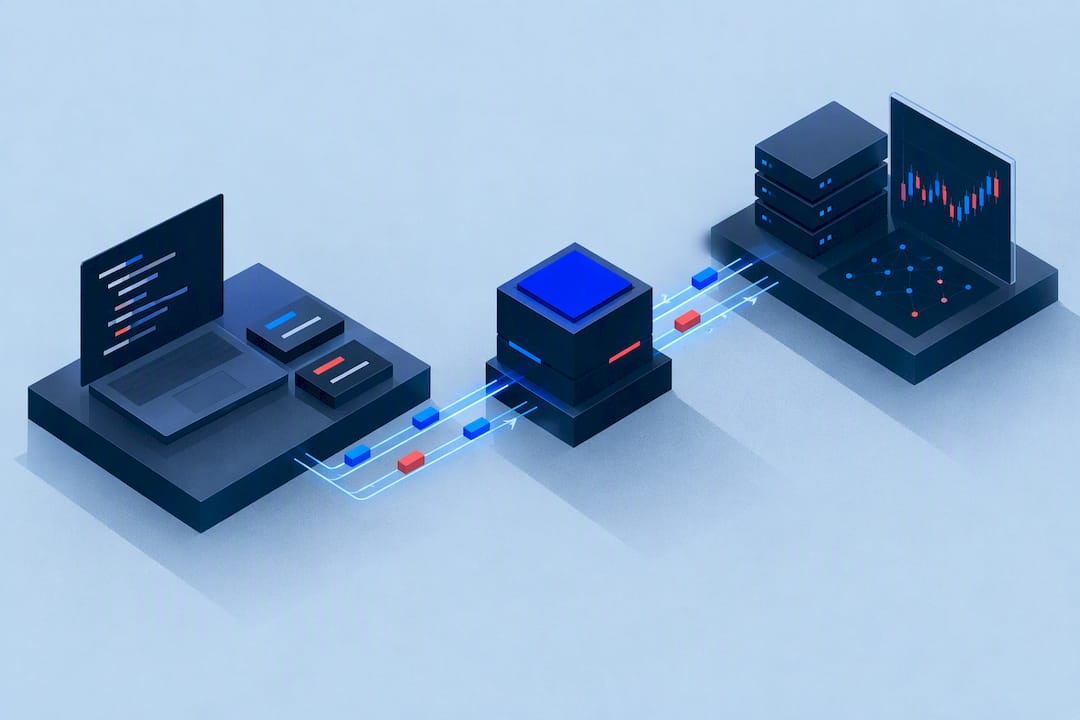
The canonical pattern for wiring an AI agent to a prediction market is REST discovery to fetch an authoritative snapshot, then a WebSocket subscription for live updates, with forecasting kept strictly separate from deterministic execution and risk controls. That separation is the single most important operational rule in this guide: a probability estimate is not a trading instruction, and the systems that turn one into the other need to be auditable, replayable, and boring.
TL;DR:
Always store and use the platform-issued instrument symbols to prevent cross-venue symbol drift, which can break data joins and cause inaccuracies.
Rebuild local state from REST snapshots whenever update IDs skip or sequence gaps occur instead of patching, to avoid silent drift in order books and trade data.
Persist both market snapshots and forecasting signals at each decision point to ensure accurate replay and backtest validation.
Separate forecasting, ranking, sizing, and risk control layers in the agent pipeline to enable auditable, reproducible, and safe decision-making.
Use combined data feeds like Assymetrix’s API to unify cross-venue market data, enabling better cross-market arbitrage and Smart Money tracking.
Assymetrixassymetrix.comBuild With Unified Market DataAssymetrix gives developers and AI agents one API for structured prediction market data across Polymarket, Kalshi, and Limitless.Explore Assymetrix
Table of Contents
What a prediction market API actually delivers
Canonical integration pattern for AI agents
Pagination, cursors, and safe historical backfills
Data quality gotchas: symbols, timestamps, and drift
Production architecture: separating forecast from execution
From forecasting to live trading without breaking things
What developer teams should prioritize first
How Assymetrix fits into this integration pattern
Sources
What a prediction market API actually delivers
A prediction market API exposes a layered data model, and knowing the layers before writing a single request saves a rewrite later. At the top sit events and markets, discoverable through endpoints that filter by status, category, or full text search. Below that are contracts and instruments, each carrying a canonical instrumentSymbol, a label, a marketState, resolution rules, and an expiry. Beneath the instrument layer is live market data: best bid, best ask, last trade price, individual trade records, and order book snapshots. For anything involving backtesting or model validation, historical artifacts matter just as much as live feeds, including trade history, OHLCV bars, and bulk exports built for replay.
Event and market discovery endpoints support filtering by status, category, and search terms.
Instrument fields include
instrumentSymbol, label,marketState, resolution rules, and expiry.Market data fields cover best bid, best ask, last trade price, trade records, and order book depth.
Historical artifacts, such as trades, OHLCV, and bulk exports, support replay and backtesting.
Canonical integration pattern for AI agents
The sequence a production agent follows is discover, snapshot, subscribe, and it holds regardless of venue. According to the Gemini developer docs on prediction market data, the standard flow is REST for discovery paired with WebSocket for live updates: resolve the event to an instrumentSymbol, pull a full snapshot, then stream bid, ask, trade, and state changes.
Call the REST discovery endpoint to list active events and pull the authoritative event definition.
Resolve the event to its canonical
instrumentSymboland fetch a full snapshot before any decision logic runs.Subscribe to the venue’s WebSocket channels, typically
bookTicker, trade, and depth, and apply each update to a local state object.Treat REST as the permanent resync source: if WebSocket sequence IDs skip, discard local state and rebuild from a fresh snapshot rather than patching around the gap.
Pro Tip: Never let an agent act on a WebSocket message before a REST snapshot has established a known-good starting state.
WebSocket order is not infallible. Networks drop packets, connections reset, and venues occasionally reorder delivery under load, so an agent that trusts stream order without a resync path will drift silently, sometimes for hours before anyone notices the numbers are wrong.

Pagination, cursors, and safe historical backfills
Cursor pagination is the reliable path for backfills, but only when the cursor is tied to the exact filter set that produced it. The Gemini prediction markets spec documents cursor semantics that assume the original filters stay constant across pages, with practical filters including venue, status, category, and search, and page sizes up to 2,000 records per call.
Persist the full filter set alongside each cursor so pagination can resume exactly where it stopped.
Restart pagination from scratch whenever a filter parameter changes: a cursor from one filter set is invalid under another.
Prefer bulk export endpoints or incremental snapshot pulls over heavy cursor churn when a backfill spans a long historical window.
Mixing filters mid-pagination is a common source of silent gaps in historical datasets, and the error rarely surfaces until a backtest produces numbers that do not reconcile against a known baseline.
Data quality gotchas: symbols, timestamps, and drift
Symbol drift is the quiet failure mode that breaks cross-venue joins. Always store the platform-returned instrumentSymbol rather than deriving an identifier from a market title or slug, since titles get edited and slugs are not guaranteed stable across a market’s lifecycle.
Use the platform-issued
instrumentSymbolas the join key; never derive one from title text or URL slugs.Track at least three timestamp types separately: server ingestion time, event observation time, and settlement time.
If update IDs skip ahead, discard the local order book and resubscribe using a fresh REST snapshot rather than patching the gap.
Build a health check that flags missed updates by comparing consecutive sequence IDs, not just connection uptime.
A single skipped update ID is enough to desynchronize a local order book indefinitely if the client keeps applying diffs instead of resyncing. The Gemini market-data reference recommends verifying continuity against a snapshot-based update ID and reinitializing state when IDs differ or skip, rather than trying to reconcile the difference in place.
Production architecture: separating forecast from execution
A reliable agent pipeline is a stack of layers, not a single model call. Data ingestion feeds a forecaster, which passes a timestamped output into a ranking and selection stage, which hands off to deterministic sizing and execution, which sits behind risk guardrails, all of it writing to audit logs. Research on the belief-to-trade layer in prediction market agents describes this separation directly: the Raven-Agent architecture places ranking, fractional-Kelly sizing, execution, and risk limits outside the language model, and reports improved risk-adjusted returns in replay testing when the split is enforced.
Ingestion normalizes cross-venue data into canonical instrument records.
The forecaster emits a timestamped probability pulse, nothing more.
Ranking and selection consume the pulse alongside Smart Money and trader-skill signals to filter candidates.
Sizing and execution apply deterministic rules: per-trade notional caps, aggregate exposure limits, and stop-loss thresholds.
Audit logs capture every layer’s inputs and outputs for later replay.
Canonical IDs across venues make Smart Money tracking and arbitrage detection tractable, since a wallet’s activity or a price divergence only means something once it can be joined against the same instrument on a second venue.
Pro Tip: Persist both the market snapshot and the forecaster’s pulse at every decision point; without both, a replay cannot reproduce what the agent actually saw.
From forecasting to live trading without breaking things
Moving from a backtest to live capital is where most agent pipelines fail, not because the forecast was wrong but because execution assumptions never got tested against real liquidity. Prediction Arena’s benchmarking work found that live and paper trading surface liquidity, timing, and slippage issues that synthetic accuracy tests never expose, which is the reason paper trading is not an optional step.
Replay archived market snapshots against your selection and execution logic before touching a paper account.
Run a paper trading phase and track calibration metrics such as Brier score or log loss, alongside realized PnL, slippage, turnover, and drawdown.
Wire those metrics into continuous integration tests so a regression in calibration or drawdown blocks deployment automatically.
Check for model monoculture before scaling: research on preference optimization in LLM prediction markets found identical-model ensembles reaching a pairwise error correlation near 0.70, with ten same-model agents providing only about as much independent information as 1.4 truly independent forecasters.
Mixing model families, prompts, or underlying data sources and measuring pairwise forecast-error correlation directly is the practical defense against that collapse in effective diversity.
What developer teams should prioritize first
Treat every price as a signal, never as an instruction, and put deterministic risk checks outside the model where they can be audited independently. Auditable logging and reproducible replay matter more than forecast accuracy in isolation, and canonical, normalized data is what makes cross-venue reasoning tractable instead of guesswork.
— Dean
How Assymetrix fits into this integration pattern
Every pattern in this guide assumes normalized, cross-venue data arrives through a single integration rather than three separate venue SDKs stitched together by hand. This is the specific gap Assymetrix’s Data API is built to close: one feed spanning Polymarket, Kalshi, and Limitless, with canonical instrument IDs that let you join Smart Money wallet activity and cross-venue arbitrage signals against the same underlying market.
The historical layer behind such a feed can run to terabytes across billions of rows of trading activity, covering replay and backfill needs without stitching together separate export jobs per venue. For a code-first starting point, the Python developer guide walks through streaming and snapshot calls end to end, and the data feed guide covers backfill and replay configuration in more depth. Start with the Data API landing page to see current access tiers and trial onboarding.
Sources
FAQ
How much historical data should an agent backfill before going live?
Enough to cover at least one full cycle of the market types you plan to trade, since resolution rules and liquidity patterns vary by category. Use export endpoints or incremental snapshot pulls for large windows rather than paginating with cursors, which is more resilient to filter changes mid-backfill.
What should trigger a full resync instead of a WebSocket reconnect?
A skipped update ID is the clearest signal: when the sequence gap appears, discard local state and rebuild from a fresh REST snapshot rather than patching the difference. Reconnecting the socket alone does not fix state that already drifted.
Which fields are mandatory to store for every trade or quote update?
At minimum, store the canonical instrumentSymbol, marketState, best bid and ask, last trade price, and all three timestamp types: server ingestion, event observation, and settlement. Missing any one of these makes later reconciliation against a second venue unreliable.
Why does model monoculture matter if my agent already performs well in backtests?
Because identical or near-identical models tend to fail in correlated ways, so an ensemble of similar agents can look diverse while actually behaving as one. Research on preference-optimized LLM ensembles found ten same-model agents carrying about as much independent signal as 1.4 truly independent forecasters, which undercuts any expected benefit from scaling up a single model family.
Do I need a separate execution layer if my forecasting model is accurate?
Yes, because accuracy in forecasting says nothing about sizing, slippage, or exposure limits, which need to be deterministic and testable on their own. Research on the belief-to-trade layer found that keeping selection, sizing, and risk controls outside the language model improved risk-adjusted returns in replay testing compared to letting the model influence execution directly.
Prediction Market APIs for Developers: REST+WebSocket, Canonical IDs
The canonical pattern for wiring an AI agent to a prediction market is REST discovery to fetch an authoritative snapshot, then a WebSocket subscription for live updates, with forecasting kept strictly separate from deterministic execution and risk controls. That separation is the single most important operational rule in this guide: a probability estimate is not a trading instruction, and the systems that turn one into the other need to be auditable, replayable, and boring.
TL;DR:
Always store and use the platform-issued instrument symbols to prevent cross-venue symbol drift, which can break data joins and cause inaccuracies.
Rebuild local state from REST snapshots whenever update IDs skip or sequence gaps occur instead of patching, to avoid silent drift in order books and trade data.
Persist both market snapshots and forecasting signals at each decision point to ensure accurate replay and backtest validation.
Separate forecasting, ranking, sizing, and risk control layers in the agent pipeline to enable auditable, reproducible, and safe decision-making.
Use combined data feeds like Assymetrix’s API to unify cross-venue market data, enabling better cross-market arbitrage and Smart Money tracking.
Assymetrixassymetrix.comBuild With Unified Market DataAssymetrix gives developers and AI agents one API for structured prediction market data across Polymarket, Kalshi, and Limitless.Explore Assymetrix
Table of Contents
What a prediction market API actually delivers
Canonical integration pattern for AI agents
Pagination, cursors, and safe historical backfills
Data quality gotchas: symbols, timestamps, and drift
Production architecture: separating forecast from execution
From forecasting to live trading without breaking things
What developer teams should prioritize first
How Assymetrix fits into this integration pattern
Sources
What a prediction market API actually delivers
A prediction market API exposes a layered data model, and knowing the layers before writing a single request saves a rewrite later. At the top sit events and markets, discoverable through endpoints that filter by status, category, or full text search. Below that are contracts and instruments, each carrying a canonical instrumentSymbol, a label, a marketState, resolution rules, and an expiry. Beneath the instrument layer is live market data: best bid, best ask, last trade price, individual trade records, and order book snapshots. For anything involving backtesting or model validation, historical artifacts matter just as much as live feeds, including trade history, OHLCV bars, and bulk exports built for replay.
Event and market discovery endpoints support filtering by status, category, and search terms.
Instrument fields include
instrumentSymbol, label,marketState, resolution rules, and expiry.Market data fields cover best bid, best ask, last trade price, trade records, and order book depth.
Historical artifacts, such as trades, OHLCV, and bulk exports, support replay and backtesting.
Canonical integration pattern for AI agents
The sequence a production agent follows is discover, snapshot, subscribe, and it holds regardless of venue. According to the Gemini developer docs on prediction market data, the standard flow is REST for discovery paired with WebSocket for live updates: resolve the event to an instrumentSymbol, pull a full snapshot, then stream bid, ask, trade, and state changes.
Call the REST discovery endpoint to list active events and pull the authoritative event definition.
Resolve the event to its canonical
instrumentSymboland fetch a full snapshot before any decision logic runs.Subscribe to the venue’s WebSocket channels, typically
bookTicker, trade, and depth, and apply each update to a local state object.Treat REST as the permanent resync source: if WebSocket sequence IDs skip, discard local state and rebuild from a fresh snapshot rather than patching around the gap.
Pro Tip: Never let an agent act on a WebSocket message before a REST snapshot has established a known-good starting state.
WebSocket order is not infallible. Networks drop packets, connections reset, and venues occasionally reorder delivery under load, so an agent that trusts stream order without a resync path will drift silently, sometimes for hours before anyone notices the numbers are wrong.
Pagination, cursors, and safe historical backfills
Cursor pagination is the reliable path for backfills, but only when the cursor is tied to the exact filter set that produced it. The Gemini prediction markets spec documents cursor semantics that assume the original filters stay constant across pages, with practical filters including venue, status, category, and search, and page sizes up to 2,000 records per call.
Persist the full filter set alongside each cursor so pagination can resume exactly where it stopped.
Restart pagination from scratch whenever a filter parameter changes: a cursor from one filter set is invalid under another.
Prefer bulk export endpoints or incremental snapshot pulls over heavy cursor churn when a backfill spans a long historical window.
Mixing filters mid-pagination is a common source of silent gaps in historical datasets, and the error rarely surfaces until a backtest produces numbers that do not reconcile against a known baseline.
Data quality gotchas: symbols, timestamps, and drift
Symbol drift is the quiet failure mode that breaks cross-venue joins. Always store the platform-returned instrumentSymbol rather than deriving an identifier from a market title or slug, since titles get edited and slugs are not guaranteed stable across a market’s lifecycle.
Use the platform-issued
instrumentSymbolas the join key; never derive one from title text or URL slugs.Track at least three timestamp types separately: server ingestion time, event observation time, and settlement time.
If update IDs skip ahead, discard the local order book and resubscribe using a fresh REST snapshot rather than patching the gap.
Build a health check that flags missed updates by comparing consecutive sequence IDs, not just connection uptime.
A single skipped update ID is enough to desynchronize a local order book indefinitely if the client keeps applying diffs instead of resyncing. The Gemini market-data reference recommends verifying continuity against a snapshot-based update ID and reinitializing state when IDs differ or skip, rather than trying to reconcile the difference in place.
Production architecture: separating forecast from execution
A reliable agent pipeline is a stack of layers, not a single model call. Data ingestion feeds a forecaster, which passes a timestamped output into a ranking and selection stage, which hands off to deterministic sizing and execution, which sits behind risk guardrails, all of it writing to audit logs. Research on the belief-to-trade layer in prediction market agents describes this separation directly: the Raven-Agent architecture places ranking, fractional-Kelly sizing, execution, and risk limits outside the language model, and reports improved risk-adjusted returns in replay testing when the split is enforced.
Ingestion normalizes cross-venue data into canonical instrument records.
The forecaster emits a timestamped probability pulse, nothing more.
Ranking and selection consume the pulse alongside Smart Money and trader-skill signals to filter candidates.
Sizing and execution apply deterministic rules: per-trade notional caps, aggregate exposure limits, and stop-loss thresholds.
Audit logs capture every layer’s inputs and outputs for later replay.
Canonical IDs across venues make Smart Money tracking and arbitrage detection tractable, since a wallet’s activity or a price divergence only means something once it can be joined against the same instrument on a second venue.
Pro Tip: Persist both the market snapshot and the forecaster’s pulse at every decision point; without both, a replay cannot reproduce what the agent actually saw.
From forecasting to live trading without breaking things
Moving from a backtest to live capital is where most agent pipelines fail, not because the forecast was wrong but because execution assumptions never got tested against real liquidity. Prediction Arena’s benchmarking work found that live and paper trading surface liquidity, timing, and slippage issues that synthetic accuracy tests never expose, which is the reason paper trading is not an optional step.
Replay archived market snapshots against your selection and execution logic before touching a paper account.
Run a paper trading phase and track calibration metrics such as Brier score or log loss, alongside realized PnL, slippage, turnover, and drawdown.
Wire those metrics into continuous integration tests so a regression in calibration or drawdown blocks deployment automatically.
Check for model monoculture before scaling: research on preference optimization in LLM prediction markets found identical-model ensembles reaching a pairwise error correlation near 0.70, with ten same-model agents providing only about as much independent information as 1.4 truly independent forecasters.
Mixing model families, prompts, or underlying data sources and measuring pairwise forecast-error correlation directly is the practical defense against that collapse in effective diversity.
What developer teams should prioritize first
Treat every price as a signal, never as an instruction, and put deterministic risk checks outside the model where they can be audited independently. Auditable logging and reproducible replay matter more than forecast accuracy in isolation, and canonical, normalized data is what makes cross-venue reasoning tractable instead of guesswork.
— Dean
How Assymetrix fits into this integration pattern
Every pattern in this guide assumes normalized, cross-venue data arrives through a single integration rather than three separate venue SDKs stitched together by hand. This is the specific gap Assymetrix’s Data API is built to close: one feed spanning Polymarket, Kalshi, and Limitless, with canonical instrument IDs that let you join Smart Money wallet activity and cross-venue arbitrage signals against the same underlying market.
The historical layer behind such a feed can run to terabytes across billions of rows of trading activity, covering replay and backfill needs without stitching together separate export jobs per venue. For a code-first starting point, the Python developer guide walks through streaming and snapshot calls end to end, and the data feed guide covers backfill and replay configuration in more depth. Start with the Data API landing page to see current access tiers and trial onboarding.
Sources
FAQ
How much historical data should an agent backfill before going live?
Enough to cover at least one full cycle of the market types you plan to trade, since resolution rules and liquidity patterns vary by category. Use export endpoints or incremental snapshot pulls for large windows rather than paginating with cursors, which is more resilient to filter changes mid-backfill.
What should trigger a full resync instead of a WebSocket reconnect?
A skipped update ID is the clearest signal: when the sequence gap appears, discard local state and rebuild from a fresh REST snapshot rather than patching the difference. Reconnecting the socket alone does not fix state that already drifted.
Which fields are mandatory to store for every trade or quote update?
At minimum, store the canonical instrumentSymbol, marketState, best bid and ask, last trade price, and all three timestamp types: server ingestion, event observation, and settlement. Missing any one of these makes later reconciliation against a second venue unreliable.
Why does model monoculture matter if my agent already performs well in backtests?
Because identical or near-identical models tend to fail in correlated ways, so an ensemble of similar agents can look diverse while actually behaving as one. Research on preference-optimized LLM ensembles found ten same-model agents carrying about as much independent signal as 1.4 truly independent forecasters, which undercuts any expected benefit from scaling up a single model family.
Do I need a separate execution layer if my forecasting model is accurate?
Yes, because accuracy in forecasting says nothing about sizing, slippage, or exposure limits, which need to be deterministic and testable on their own. Research on the belief-to-trade layer found that keeping selection, sizing, and risk controls outside the language model improved risk-adjusted returns in replay testing compared to letting the model influence execution directly.
Other Blog


