900M+ Events: Unified Prediction Market API for Developers
900M+ Events: Unified Prediction Market API for Developers
900M+ Events: Unified Prediction Market API for Developers
Unified cross-venue prediction market data for devs: real-time quotes, orderbook depth, and 900M+ indexed events for reliable backtests and fast...
900M+ Events: Unified Prediction Market API for Developers
A prediction market API delivers real-time quotes, orderbook depth, trade flow, wallet activity, settlement records, and historical OHLCV candles through REST and WebSocket endpoints. Developers, quants, and AI agent builders need this data programmatically, and pulling it from a single unified provider beats stitching together three separate venue integrations. The Assymetrix Data API is built for exactly this job. Start there.
TL;DR:
A prediction market API must provide comprehensive real-time data, historical records, and wallet activity to support effective trading strategies; shallow endpoints are insufficient.
Using a unified cross-venue API reduces schema normalization effort, latency, and data inconsistency issues compared to building multiple individual connectors.
Integration with such an API involves five core endpoints—quotes, trades, price history, streams, and orders—and requires handling identifier resolution, market discovery, and order lifecycle management.
The main limitations include rate limits, data latency, variable historical coverage, and differing granularity across venues, which can impact strategy accuracy and backtesting.
Adopting a unified API is advantageous for quick prototyping, deep historical backtesting, and cross-venue signals, whereas building custom connectors is justified only for exclusive features or strict settlement control.
Table of Contents
What Does a Prediction Market API Need to Provide?
Why a Unified Cross-Venue API Beats Building Your Own Connectors
How Do You Integrate a Prediction Market Data API?
What Can You Actually Build With This Data?
What Does Assymetrix Actually Offer Developers?
How Does API Versioning Work for Prediction Market Data?
What Are the Limitations of Prediction Market APIs?
When Should You Adopt a Unified API Versus Building Your Own?
How to Get Started With the Assymetrix Data API
Sources
What Does a Prediction Market API Need to Provide?
A production-grade prediction market API has to cover the full lifecycle of a trade, not just a snapshot of current odds. If you’re evaluating providers, check for these outputs before you write a single line of integration code.
Real-time feeds. You need live quotes (best bid/offer), full orderbook depth, and a trade tape showing fills as they happen. Shallow “current price” endpoints without depth are useless for anything beyond dashboard display.
Streaming primitives. WebSocket topics should push discrete events with clear framing, and the provider should tell you plainly whether delivery is best effort or guaranteed. Synchronized WebSocket streams are considered mandatory for anyone trying to capture short-lived cross-venue mispricing, since polling REST endpoints introduces lag that erases the edge.
Historical data. This means full trade history, resolution and verification records showing how a market actually settled, and OHLCV candles at multiple granularities. A one-week archive is not enough to stress-test a strategy against a real volatility regime.
Wallet and participant data. Wallet-level activity and trader histories are what let you build smart-money detection instead of just watching aggregate volume.
Operational plumbing. This is the unglamorous part that determines whether your integration survives contact with production:
Canonical IDs and slug resolution so a market means the same thing across venues
Documented cursor pagination rules, including sort-order caveats
Clear authentication flow and published rate limits
Consistent expansion parameters for multi-outcome events
Miss any one of these and you’ll spend more time debugging ingestion than building signal.
Why a Unified Cross-Venue API Beats Building Your Own Connectors
Every prediction market venue formats its data differently, and reconciling those differences yourself is what’s often called the normalization tax. Slug formats vary. Resolution windows vary. Multi-outcome events expand differently depending on the venue’s own schema. Build three separate connectors for Polymarket, Kalshi, and Limitless, and you’re paying that tax three times, then paying it again every time one venue changes its API without warning.
A unified cross-venue API reduces this tax by handling schema normalization server-side and exposing one consistent data model regardless of origin. Assymetrix’s Data API runs this on an infrastructure indexing 900M+ events and more than 2 billion rows of cross-venue data, which means the normalization work has already been done at scale before you ever call an endpoint.
The engineering payoff compounds:
One WebSocket connection instead of three, which matters directly for latency-sensitive arbitrage detection
One authentication model and one pagination scheme instead of three sets of quirks to memorize
Consolidated historical archives for backtesting instead of merging three inconsistent exports by hand
Canonical slugs that stay stable even when an individual venue renames or restructures a market
Pro Tip: Don’t underestimate how much backtest bias creeps in when you merge historical data from separate venue exports by hand. Small timestamp drift between sources can silently distort your fill assumptions across thousands of simulated trades.
The real advantage isn’t convenience. It’s that your team spends its time on signal generation instead of ingestion maintenance.
How Do You Integrate a Prediction Market Data API?
Most unified APIs converge on a small set of primitives: quote, trades, price_history, stream, and orders. Learning these five endpoints gets you further than memorizing a dozen venue-specific quirks.
Discover markets. Call
GET /v1/marketsto pull the active catalog. Use cursor-based pagination for exhaustive walks. Sorting by volume can trigger over-fetch behavior on some venues, so reserve ordered top-N queries for cases where you don’t need every row.Resolve identifiers. Aggregator APIs accept Kalshi tickers and Polymarket slugs interchangeably, normalizing them server-side against a canonical ID. Cache that slug-to-token mapping locally if you’re running high request volume.
Pull historical context. Use
price_historyfor OHLCV candles at your required granularity, then check settlement status against the resolution record before you trust a backtest fill.Subscribe to streams. Open one WebSocket connection and subscribe to topics like
new_markets,market_resolved, and live quote updates. Keep a local orderbook and reconcile it periodically against a REST snapshot to catch dropped messages.Handle order lifecycle.
POST /v1/ordersplaces trades; redeem and settlement endpoints vary by venue mode. Some venues auto-settle, others require a relayer or on-chain redeem step, and a well-built API exposes both through one uniform/v1/settlementendpoint.
For production readiness, build retry with exponential backoff on every REST call, respect published rate limits before you get throttled, and reconcile your local state against the API’s source of truth on a fixed interval, not just on error.
What Can You Actually Build With This Data?
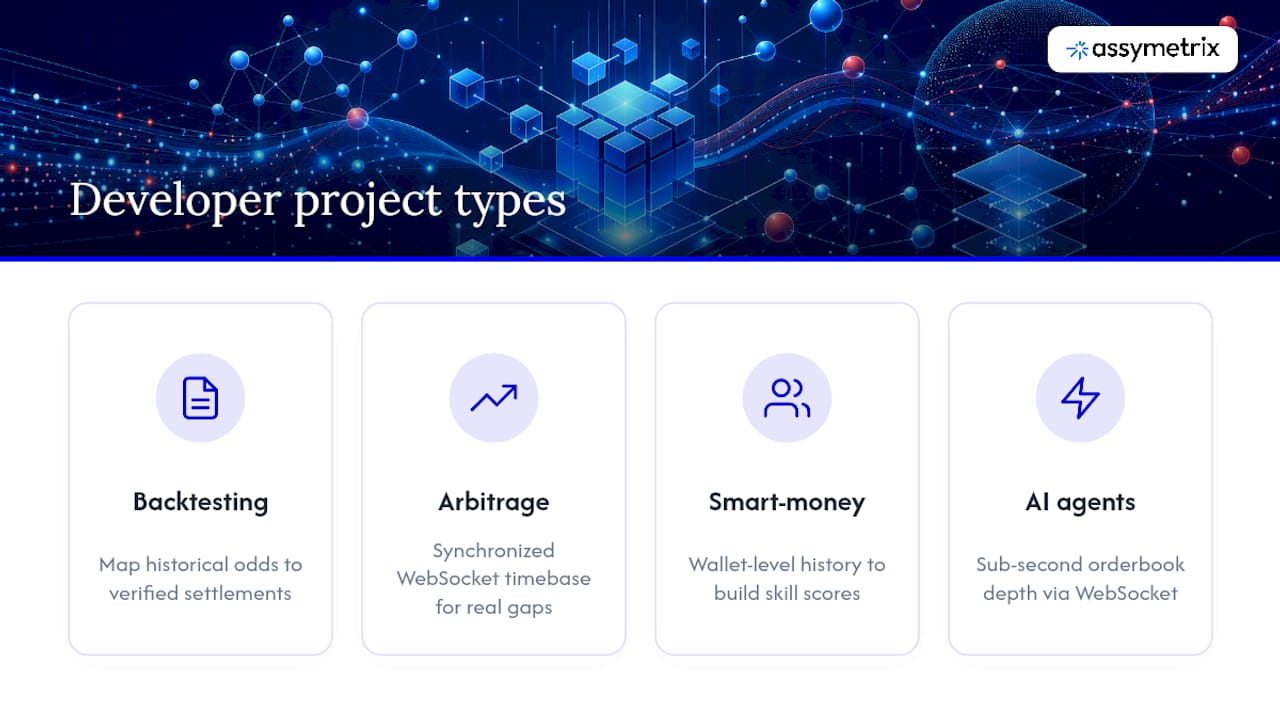
The outputs above map directly onto four developer projects that show up constantly in prediction market engineering.
Backtesting. Map historical odds against verified settlement records, not just closing price, since a strategy that looks profitable against unresolved markets will fall apart in live trading. You need enough historical depth to stress a strategy across multiple volatility regimes, not just one calm month.
Cross-venue arbitrage. Detecting a price gap between Polymarket and Kalshi on the same underlying event requires synchronized data. A single WebSocket connection with a consistent timebase is what lets you trust that a divergence is real and not an artifact of two feeds updating at different speeds.
Smart-money tracking. Wallet-level trade history lets you build trader-skill scores and flag when historically accurate wallets are accumulating a position, which is a meaningfully different signal than raw volume.
AI agents. Live decision loops need sub-second access to orderbook depth via WebSocket, because polling introduces exactly the kind of lag that erases a transient edge before the agent can act on it.
Whichever project you’re building, track fill-rate and latency against a baseline so you notice degradation before it costs you money, and use a partner resource like Tickerly’s guide to data-driven algorithmic strategies if you want a broader view on how data quality shapes model performance.
What Does Assymetrix Actually Offer Developers?
Assymetrix runs a unified REST and WebSocket Data API indexing more than 900 million events and over 2 billion rows of cross-venue trading activity across Polymarket, Kalshi, and Limitless. That scale is what makes deep historical backtests possible without stitching together three inconsistent venue exports.
Developers get a documented API reference and a Python quickstart for fast onboarding, alongside platform features built specifically for quant workflows: Smart Money wallet tracking, Trader Skill Scores, and cross-venue arbitrage signals surfaced directly from the same underlying dataset.
The intelligence layer runs the analytics. The API is how you get the raw feed underneath it.
How Does API Versioning Work for Prediction Market Data?
Versioning matters more in prediction market APIs than in most data APIs, because the underlying venues themselves change schemas without much notice. A venue might add a new outcome-expansion mode or alter how it reports settlement status, and your integration shouldn’t break the moment that happens.
Look for a provider that versions its endpoints explicitly (/v1/markets, not an unversioned root path) and publishes a deprecation window before retiring an old version. A six-month or longer overlap between v1 and v2 gives you room to migrate without a scramble.
Backward compatibility usually breaks in a few predictable places: field additions are safe, field renames are not, and changes to how multi-outcome events expand into rows can silently corrupt a pipeline that assumed one row per market. Test your integration against a staging or sandbox environment whenever a provider announces a version bump, and pin your client to a specific version rather than always pulling latest in production. A one-line changelog entry from the provider is far cheaper to read than a broken settlement reconciliation job at 2 a.m.
If a provider doesn’t publish versioning documentation at all, treat that as a red flag. It usually means breaking changes ship without warning.
What Are the Limitations of Prediction Market APIs?
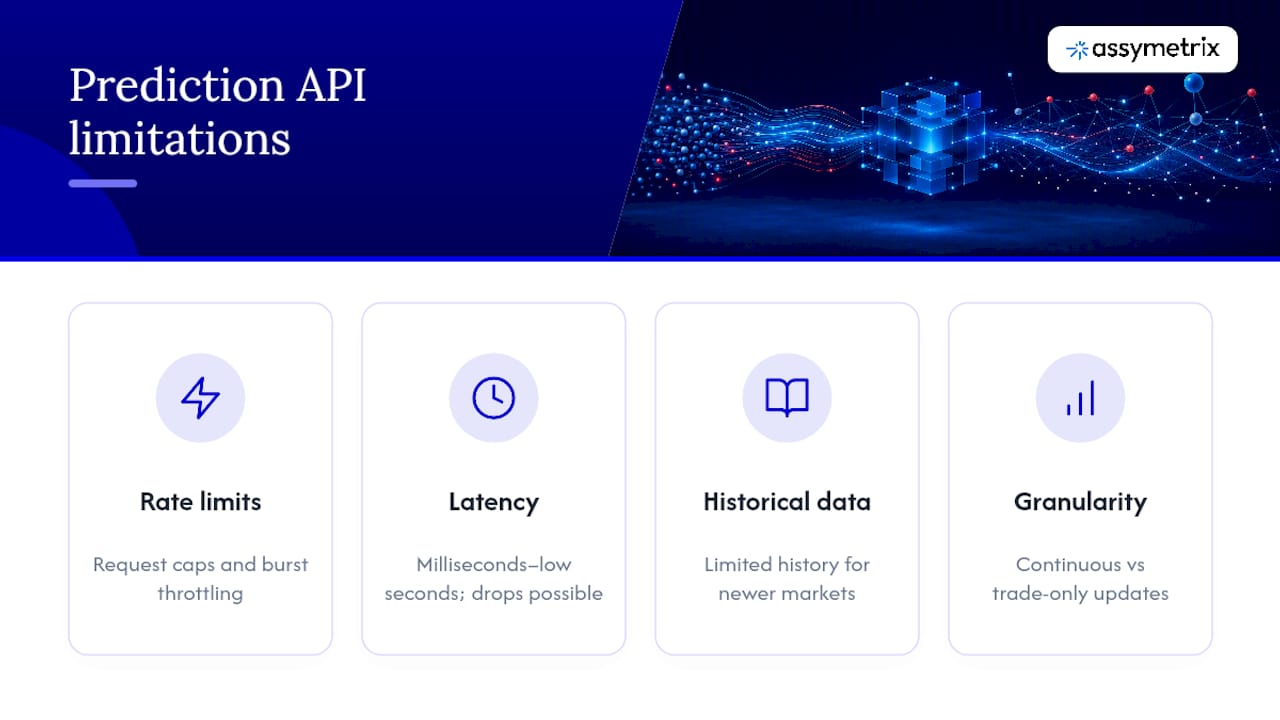
No prediction market API, unified or otherwise, eliminates every constraint you’ll run into. Rate limits are the most immediate one: even generous tiers cap request volume, and burst limits during high-volatility events (an election night, a Fed decision) can throttle you exactly when data matters most. Design your polling and streaming logic to degrade gracefully rather than crash on a 429 response.
Data latency is another real constraint. WebSocket delivery is typically fast, but “real-time” still carries network and processing delay measured in milliseconds to low seconds, and best-effort delivery means you should never assume zero dropped messages. Reconciliation against REST snapshots is not optional if your strategy depends on exact fill sequencing.
Historical coverage also varies by venue and by how long that venue has existed. Newer markets on any platform simply don’t have years of resolution data behind them, which limits how far back you can backtest a strategy tied to a specific market type.
Finally, not every venue exposes the same granularity. Some markets update quotes continuously, others only on trade events, and a provider aggregating across venues has to be transparent about which model applies to which market rather than papering over the difference with a synthetic candle.
When Should You Adopt a Unified API Versus Building Your Own?
Adopt a unified API when you need cross-venue signals, fast time-to-signal, and historical depth you can’t realistically build alone. Building bespoke connectors only makes sense when you need an exclusive on-venue feature or absolute control over settlement plumbing that a shared API abstracts away.
Before deciding, run this checklist: how fast do you need to prototype, how much historical data does your strategy actually require, how much ops bandwidth can you dedicate to maintaining connectors, and does your compliance posture demand direct settlement control? For most quant teams and bot builders, the answer favors the unified path.
How to Get Started With the Assymetrix Data API
If you’ve read this far, you already know the core problem: building and maintaining three separate venue integrations eats engineering time that should go toward strategy, not schema wrangling. Assymetrix removes that overhead with one REST and WebSocket integration covering Polymarket, Kalshi, and Limitless, backed by 900M+ indexed events and 2+ billion rows of historical data.
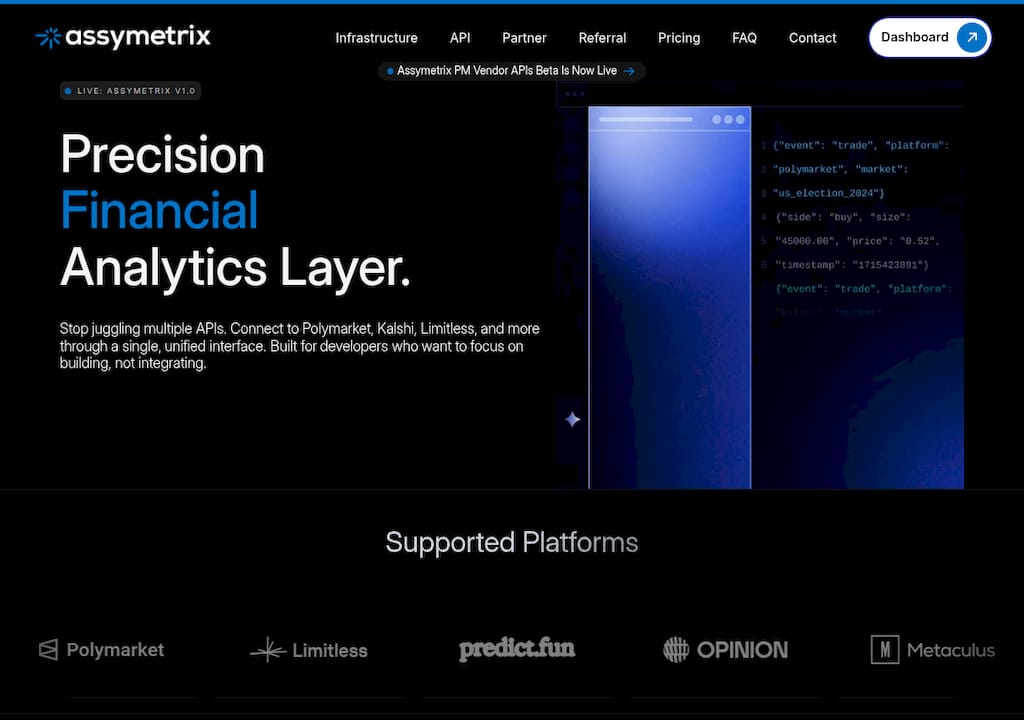
Onboarding is built for developers who want to move fast. Start with the API reference and docs, then run two quick tests: call GET /v1/markets to confirm catalog access, then subscribe to /v1/ws/quotes for a live feed on a market you already know the odds for. If you’d rather work in Python first, the Python developer guide gets you a working script in a few lines.
Assymetrix offers free and paid tiers depending on your data volume and streaming needs, plus commercial license options for teams building products on top of the feed. Get your API key and start testing at data.assymetrix.com/api.
Sources
FAQ
Is the Polymarket API Free?
Polymarket’s own native API access has usage limits and is not designed for heavy cross-venue quant work; a unified provider like Assymetrix offers free and paid tiers depending on data volume and streaming requirements.
Can I Make My Own Prediction Market?
Building a prediction market platform is technically possible but involves significant legal, regulatory, and settlement infrastructure work well beyond API integration, and this falls outside programmatic data access.
Are Prediction Markets Legal in the US?
Legal status varies by market structure and regulatory classification, with platforms like Kalshi operating under CFTC-regulated frameworks; developers should consult the specific venue’s compliance documentation and a qualified attorney for their exact use case rather than treat any single answer as universal.
What Is the Best AI for Prediction Markets?
There’s no single “best” AI model since agent performance depends entirely on data quality and latency; AI agents need sub-second access to orderbook depth to act on transient signals, which makes the underlying data feed a bigger factor than model choice alone.
900M+ Events: Unified Prediction Market API for Developers
A prediction market API delivers real-time quotes, orderbook depth, trade flow, wallet activity, settlement records, and historical OHLCV candles through REST and WebSocket endpoints. Developers, quants, and AI agent builders need this data programmatically, and pulling it from a single unified provider beats stitching together three separate venue integrations. The Assymetrix Data API is built for exactly this job. Start there.
TL;DR:
A prediction market API must provide comprehensive real-time data, historical records, and wallet activity to support effective trading strategies; shallow endpoints are insufficient.
Using a unified cross-venue API reduces schema normalization effort, latency, and data inconsistency issues compared to building multiple individual connectors.
Integration with such an API involves five core endpoints—quotes, trades, price history, streams, and orders—and requires handling identifier resolution, market discovery, and order lifecycle management.
The main limitations include rate limits, data latency, variable historical coverage, and differing granularity across venues, which can impact strategy accuracy and backtesting.
Adopting a unified API is advantageous for quick prototyping, deep historical backtesting, and cross-venue signals, whereas building custom connectors is justified only for exclusive features or strict settlement control.
Table of Contents
What Does a Prediction Market API Need to Provide?
Why a Unified Cross-Venue API Beats Building Your Own Connectors
How Do You Integrate a Prediction Market Data API?
What Can You Actually Build With This Data?
What Does Assymetrix Actually Offer Developers?
How Does API Versioning Work for Prediction Market Data?
What Are the Limitations of Prediction Market APIs?
When Should You Adopt a Unified API Versus Building Your Own?
How to Get Started With the Assymetrix Data API
Sources
What Does a Prediction Market API Need to Provide?
A production-grade prediction market API has to cover the full lifecycle of a trade, not just a snapshot of current odds. If you’re evaluating providers, check for these outputs before you write a single line of integration code.
Real-time feeds. You need live quotes (best bid/offer), full orderbook depth, and a trade tape showing fills as they happen. Shallow “current price” endpoints without depth are useless for anything beyond dashboard display.
Streaming primitives. WebSocket topics should push discrete events with clear framing, and the provider should tell you plainly whether delivery is best effort or guaranteed. Synchronized WebSocket streams are considered mandatory for anyone trying to capture short-lived cross-venue mispricing, since polling REST endpoints introduces lag that erases the edge.
Historical data. This means full trade history, resolution and verification records showing how a market actually settled, and OHLCV candles at multiple granularities. A one-week archive is not enough to stress-test a strategy against a real volatility regime.
Wallet and participant data. Wallet-level activity and trader histories are what let you build smart-money detection instead of just watching aggregate volume.
Operational plumbing. This is the unglamorous part that determines whether your integration survives contact with production:
Canonical IDs and slug resolution so a market means the same thing across venues
Documented cursor pagination rules, including sort-order caveats
Clear authentication flow and published rate limits
Consistent expansion parameters for multi-outcome events
Miss any one of these and you’ll spend more time debugging ingestion than building signal.
Why a Unified Cross-Venue API Beats Building Your Own Connectors
Every prediction market venue formats its data differently, and reconciling those differences yourself is what’s often called the normalization tax. Slug formats vary. Resolution windows vary. Multi-outcome events expand differently depending on the venue’s own schema. Build three separate connectors for Polymarket, Kalshi, and Limitless, and you’re paying that tax three times, then paying it again every time one venue changes its API without warning.
A unified cross-venue API reduces this tax by handling schema normalization server-side and exposing one consistent data model regardless of origin. Assymetrix’s Data API runs this on an infrastructure indexing 900M+ events and more than 2 billion rows of cross-venue data, which means the normalization work has already been done at scale before you ever call an endpoint.
The engineering payoff compounds:
One WebSocket connection instead of three, which matters directly for latency-sensitive arbitrage detection
One authentication model and one pagination scheme instead of three sets of quirks to memorize
Consolidated historical archives for backtesting instead of merging three inconsistent exports by hand
Canonical slugs that stay stable even when an individual venue renames or restructures a market
Pro Tip: Don’t underestimate how much backtest bias creeps in when you merge historical data from separate venue exports by hand. Small timestamp drift between sources can silently distort your fill assumptions across thousands of simulated trades.
The real advantage isn’t convenience. It’s that your team spends its time on signal generation instead of ingestion maintenance.
How Do You Integrate a Prediction Market Data API?
Most unified APIs converge on a small set of primitives: quote, trades, price_history, stream, and orders. Learning these five endpoints gets you further than memorizing a dozen venue-specific quirks.
Discover markets. Call
GET /v1/marketsto pull the active catalog. Use cursor-based pagination for exhaustive walks. Sorting by volume can trigger over-fetch behavior on some venues, so reserve ordered top-N queries for cases where you don’t need every row.Resolve identifiers. Aggregator APIs accept Kalshi tickers and Polymarket slugs interchangeably, normalizing them server-side against a canonical ID. Cache that slug-to-token mapping locally if you’re running high request volume.
Pull historical context. Use
price_historyfor OHLCV candles at your required granularity, then check settlement status against the resolution record before you trust a backtest fill.Subscribe to streams. Open one WebSocket connection and subscribe to topics like
new_markets,market_resolved, and live quote updates. Keep a local orderbook and reconcile it periodically against a REST snapshot to catch dropped messages.Handle order lifecycle.
POST /v1/ordersplaces trades; redeem and settlement endpoints vary by venue mode. Some venues auto-settle, others require a relayer or on-chain redeem step, and a well-built API exposes both through one uniform/v1/settlementendpoint.
For production readiness, build retry with exponential backoff on every REST call, respect published rate limits before you get throttled, and reconcile your local state against the API’s source of truth on a fixed interval, not just on error.
What Can You Actually Build With This Data?
The outputs above map directly onto four developer projects that show up constantly in prediction market engineering.
Backtesting. Map historical odds against verified settlement records, not just closing price, since a strategy that looks profitable against unresolved markets will fall apart in live trading. You need enough historical depth to stress a strategy across multiple volatility regimes, not just one calm month.
Cross-venue arbitrage. Detecting a price gap between Polymarket and Kalshi on the same underlying event requires synchronized data. A single WebSocket connection with a consistent timebase is what lets you trust that a divergence is real and not an artifact of two feeds updating at different speeds.
Smart-money tracking. Wallet-level trade history lets you build trader-skill scores and flag when historically accurate wallets are accumulating a position, which is a meaningfully different signal than raw volume.
AI agents. Live decision loops need sub-second access to orderbook depth via WebSocket, because polling introduces exactly the kind of lag that erases a transient edge before the agent can act on it.
Whichever project you’re building, track fill-rate and latency against a baseline so you notice degradation before it costs you money, and use a partner resource like Tickerly’s guide to data-driven algorithmic strategies if you want a broader view on how data quality shapes model performance.
What Does Assymetrix Actually Offer Developers?
Assymetrix runs a unified REST and WebSocket Data API indexing more than 900 million events and over 2 billion rows of cross-venue trading activity across Polymarket, Kalshi, and Limitless. That scale is what makes deep historical backtests possible without stitching together three inconsistent venue exports.
Developers get a documented API reference and a Python quickstart for fast onboarding, alongside platform features built specifically for quant workflows: Smart Money wallet tracking, Trader Skill Scores, and cross-venue arbitrage signals surfaced directly from the same underlying dataset.
The intelligence layer runs the analytics. The API is how you get the raw feed underneath it.
How Does API Versioning Work for Prediction Market Data?
Versioning matters more in prediction market APIs than in most data APIs, because the underlying venues themselves change schemas without much notice. A venue might add a new outcome-expansion mode or alter how it reports settlement status, and your integration shouldn’t break the moment that happens.
Look for a provider that versions its endpoints explicitly (/v1/markets, not an unversioned root path) and publishes a deprecation window before retiring an old version. A six-month or longer overlap between v1 and v2 gives you room to migrate without a scramble.
Backward compatibility usually breaks in a few predictable places: field additions are safe, field renames are not, and changes to how multi-outcome events expand into rows can silently corrupt a pipeline that assumed one row per market. Test your integration against a staging or sandbox environment whenever a provider announces a version bump, and pin your client to a specific version rather than always pulling latest in production. A one-line changelog entry from the provider is far cheaper to read than a broken settlement reconciliation job at 2 a.m.
If a provider doesn’t publish versioning documentation at all, treat that as a red flag. It usually means breaking changes ship without warning.
What Are the Limitations of Prediction Market APIs?
No prediction market API, unified or otherwise, eliminates every constraint you’ll run into. Rate limits are the most immediate one: even generous tiers cap request volume, and burst limits during high-volatility events (an election night, a Fed decision) can throttle you exactly when data matters most. Design your polling and streaming logic to degrade gracefully rather than crash on a 429 response.
Data latency is another real constraint. WebSocket delivery is typically fast, but “real-time” still carries network and processing delay measured in milliseconds to low seconds, and best-effort delivery means you should never assume zero dropped messages. Reconciliation against REST snapshots is not optional if your strategy depends on exact fill sequencing.
Historical coverage also varies by venue and by how long that venue has existed. Newer markets on any platform simply don’t have years of resolution data behind them, which limits how far back you can backtest a strategy tied to a specific market type.
Finally, not every venue exposes the same granularity. Some markets update quotes continuously, others only on trade events, and a provider aggregating across venues has to be transparent about which model applies to which market rather than papering over the difference with a synthetic candle.
When Should You Adopt a Unified API Versus Building Your Own?
Adopt a unified API when you need cross-venue signals, fast time-to-signal, and historical depth you can’t realistically build alone. Building bespoke connectors only makes sense when you need an exclusive on-venue feature or absolute control over settlement plumbing that a shared API abstracts away.
Before deciding, run this checklist: how fast do you need to prototype, how much historical data does your strategy actually require, how much ops bandwidth can you dedicate to maintaining connectors, and does your compliance posture demand direct settlement control? For most quant teams and bot builders, the answer favors the unified path.
How to Get Started With the Assymetrix Data API
If you’ve read this far, you already know the core problem: building and maintaining three separate venue integrations eats engineering time that should go toward strategy, not schema wrangling. Assymetrix removes that overhead with one REST and WebSocket integration covering Polymarket, Kalshi, and Limitless, backed by 900M+ indexed events and 2+ billion rows of historical data.
Onboarding is built for developers who want to move fast. Start with the API reference and docs, then run two quick tests: call GET /v1/markets to confirm catalog access, then subscribe to /v1/ws/quotes for a live feed on a market you already know the odds for. If you’d rather work in Python first, the Python developer guide gets you a working script in a few lines.
Assymetrix offers free and paid tiers depending on your data volume and streaming needs, plus commercial license options for teams building products on top of the feed. Get your API key and start testing at data.assymetrix.com/api.
Sources
FAQ
Is the Polymarket API Free?
Polymarket’s own native API access has usage limits and is not designed for heavy cross-venue quant work; a unified provider like Assymetrix offers free and paid tiers depending on data volume and streaming requirements.
Can I Make My Own Prediction Market?
Building a prediction market platform is technically possible but involves significant legal, regulatory, and settlement infrastructure work well beyond API integration, and this falls outside programmatic data access.
Are Prediction Markets Legal in the US?
Legal status varies by market structure and regulatory classification, with platforms like Kalshi operating under CFTC-regulated frameworks; developers should consult the specific venue’s compliance documentation and a qualified attorney for their exact use case rather than treat any single answer as universal.
What Is the Best AI for Prediction Markets?
There’s no single “best” AI model since agent performance depends entirely on data quality and latency; AI agents need sub-second access to orderbook depth to act on transient signals, which makes the underlying data feed a bigger factor than model choice alone.
Other Blog


